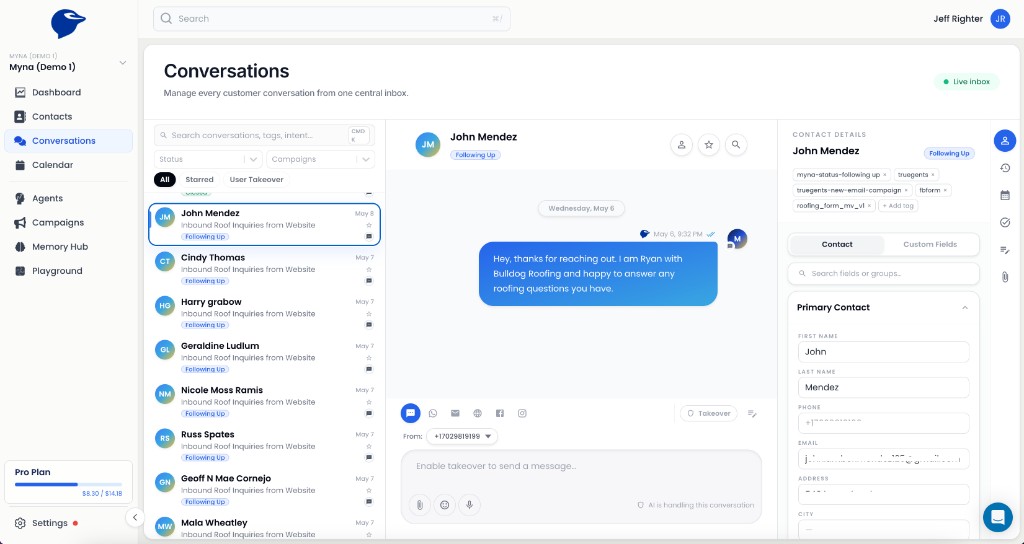




TL;DR: Human appointment setters cost $4,500–$7,000/month fully loaded. AI appointment setters cost $60–$400/month. AI wins on speed, consistency, coverage, and scale. Humans still win on complex rapport-building and genuine improvisation. For most service businesses — contractors, HVAC, roofing, solar, plumbing — the right setup is AI for top-of-funnel outreach and a human for closing.
Hiring a human appointment setter feels safe. It’s a known quantity — someone you can train, manage, and hold accountable. An AI appointment setter feels like a gamble, especially if you’ve never used one and the demos you’ve seen look too polished to be real.
But the “safe” choice has a cost that most business owners don’t fully calculate until they’re already paying it. And the “gamble” has gotten a lot less risky in the past two years as the technology has matured from glorified chatbots into systems that can genuinely hold a conversation.
This is a direct comparison — what each option actually costs, where each one breaks down, and which one makes more sense depending on how your business operates.
What a Human Appointment Setter Actually Costs
The base salary for an appointment setter in the United States ranges from $35,000 to $55,000 per year according to Bureau of Labor Statistics data on inside sales roles. That’s $2,900 to $4,600 per month before you account for anything else.
Add employer-side payroll taxes — Social Security, Medicare, federal and state unemployment — and you’re adding roughly 15% on top of base salary. Health insurance, if you offer it, adds another $500 to $700 per month per employee on average based on Kaiser Family Foundation employer health benefits survey data. Paid time off, sick days, and holidays represent another 10 to 15 working days per year where you’re paying for someone who isn’t producing.
Then there’s the cost that doesn’t show up on any payroll report: ramp time. A new appointment setter typically takes four to eight weeks to get up to speed on your product, your scripts, your objection handling, and your booking process. During that window you’re paying full salary for partial output.
The fully-loaded cost of a single human appointment setter, when you add up salary, taxes, benefits, and ramp time, lands somewhere between $4,500 and $7,000 per month. For a small service business, that’s a significant line item.
And that’s assuming things go well. Turnover in inside sales roles is high. The average tenure for an SDR or appointment setter is under 18 months according to Bridge Group research on sales development. When someone leaves, you absorb the recruiting cost — job boards, time spent interviewing, and starting the ramp process over again.
What an AI Appointment Setter Actually Costs
Platform fees for AI appointment setters range from free to around $500 per month depending on the tool and the features included. Usage costs — SMS segments, AI generation fees, carrier fees — add to that based on volume.
At realistic usage for a service business running active lead follow-up, total monthly cost including platform and usage typically lands between $60 and $200 per month. High-volume operations running thousands of conversations might reach $300 to $400.
There is no ramp time. There are no payroll taxes. There are no sick days, no PTO, no turnover, no re-hiring.
The cost comparison isn’t close.
What a Human Does Better
This isn’t a one-sided argument. Human appointment setters have real advantages that AI hasn’t fully replicated.
Genuine improvisation. When a lead goes completely off-script — gets angry, makes a joke, brings up something completely unrelated to the purpose of the call — a human can navigate that naturally. The best human setters read tone and energy and adjust in real time in ways that AI still struggles to match in genuinely unusual situations.
Complex trust-building. In industries where the sales cycle is long and the purchase decision is significant — commercial construction contracts, enterprise software, high-end consulting — human setters build rapport that converts. A 20-minute phone conversation with a sharp human rep can do things that a text message sequence cannot.
Judgment calls. A human setter can decide in the moment that a lead isn’t worth pursuing, or that a situation requires escalating to a senior rep immediately. They apply contextual judgment that goes beyond the parameters they’ve been given.
If your business closes high-ticket deals that require extensive relationship-building before any meeting gets booked, a human setter has real value that’s hard to replace entirely.
Where Human Setters Consistently Fail
The case for human appointment setters looks better on paper than it performs in practice, and the reason is almost always the same: consistency.
Follow-up discipline breaks down. Research from InsideSales.com found that 44% of salespeople give up after one follow-up attempt, while studies consistently show it takes five to eight touchpoints to convert a lead into a meeting. The gap between what follow-up should look like and what it actually looks like when a human is managing 40 leads simultaneously is where most revenue gets lost.
Speed to first contact is slow. A Harvard Business Review study found that companies that contacted leads within one hour were seven times more likely to qualify them than those that waited even two hours. Most businesses with human setters aren’t contacting leads within an hour. They’re contacting them the next morning, or after lunch, or whenever someone gets around to it.
Coverage is limited. Human setters work business hours. Leads come in at 9pm on a Tuesday when someone is watching TV and finally decides to get a quote on that roof they’ve been putting off. Nobody responds until morning. By then, two or three competitors may have already made contact.
Volume creates quality problems. When lead volume spikes — after a big ad campaign, during peak season — human setters get overwhelmed. Response times slow down, follow-up gets skipped, and leads fall through the cracks at exactly the moment when the pipeline should be filling up fastest.
Where AI Appointment Setters Consistently Win
Speed. A properly configured AI appointment setter sends the first message within seconds of a lead coming in. Not minutes. Not hours. Seconds. At the volume and consistency that lead conversion research says actually matters.
Follow-up that never stops. The AI doesn’t decide a lead is dead after two attempts. It follows a sequence until there’s a clear response — yes, no, or the window closes. No leads get forgotten because someone was busy.
24/7 availability. Leads that come in at 11pm get a response at 11pm. The follow-up sequence runs on weekends. There’s no concept of off-hours.
Unlimited simultaneous conversations. One human setter handles one conversation at a time. An AI handles 500 simultaneously with identical quality. When your ad spend doubles and lead volume spikes overnight, the AI doesn’t get overwhelmed.
Consistency across every conversation. Every lead gets the same quality of outreach. There are no bad days, no distracted afternoons, no Monday morning lag. The messaging is identical whether it’s the first conversation of the day or the five hundredth.
Cost at scale. The economics become even more favorable as volume increases. Adding a second human setter doubles your cost. Doubling your AI conversation volume might add $30 to your monthly bill.
The Comparison at a Glance
| Human Setter | AI Appointment Setter | |
|---|---|---|
| Monthly cost | $4,500–$7,000 | $60–$400 |
| Hours of operation | Business hours | 24/7 |
| Speed to first contact | Minutes to hours | Seconds |
| Simultaneous conversations | 1 | Unlimited |
| Follow-up consistency | Variable | 100% |
| Ramp time | 4–8 weeks | Minutes |
| Handles volume spikes | Poorly | Seamlessly |
| Genuine improvisation | Strong | Limited |
| Complex rapport-building | Strong | Moderate |
| Turnover risk | High | None |
The Hybrid Approach Most Businesses Land On
The businesses getting the best results from AI appointment setters aren’t using it to replace their entire sales function. They’re using it to handle everything up to the point where a human needs to be involved.
The AI makes first contact, runs the follow-up sequence, qualifies the lead against specific criteria, and books the appointment. A human — the owner, a closer, a senior sales rep — shows up to that appointment already knowing the lead is qualified and ready to talk. The human’s time goes toward closing, not chasing.
That split makes both resources more effective. The AI does the volume work it’s genuinely better at. The human does the relationship work they’re genuinely better at. The total cost of that combination is still a fraction of what a full human appointment setting team would run.
Which One Is Right for Your Business
Go with AI if:
- You have consistent lead volume from ads, referrals, or an existing CRM
- Your sales process starts with a quote, consultation, or site visit
- You’re losing leads to slow follow-up or inconsistent outreach
- You have old contacts sitting in a spreadsheet that nobody has followed up with
- You want to scale without adding headcount
Stick with human if:
- Your sales cycle requires deep relationship-building from the very first contact
- Your deal size is high enough to justify the cost and the personal touch genuinely moves the needle
- You have no systematic lead flow and operate entirely on referrals
Use both if:
- You want AI handling volume outreach and qualification, with humans closing the deals that come through
For most service businesses — contractors, HVAC, roofing, solar, plumbing — the answer is AI for the top of the funnel and human judgment for the close. That’s the setup that gets the most appointments booked at the lowest cost per meeting.
Sources
- U.S. Bureau of Labor Statistics — Occupational Employment and Wage Statistics, Inside Sales Representatives. bls.gov/oes/current/oes419099.htm
- Kaiser Family Foundation — Employer Health Benefits Annual Survey. kff.org/health-costs/report/employer-health-benefits-annual-survey/
- The Bridge Group — Sales Development Metrics and Compensation Research. bridgegroupinc.com/blog/sdr-metrics-and-compensation
- InsideSales.com — Lead Response Management Study. insidesales.com/lead-response-management/
- Harvard Business Review — "The Short Life of Online Sales Leads." hbr.org/2011/03/the-short-life-of-online-sales
Related: