
TL;DR: Most agencies live on project fees and retainers, which are fragile. They are the first thing a client cuts, and every month starts with revenue at risk. SMS automation is one of the few things an agency can sell as genuine recurring revenue because it produces a result clients can see: conversations handled and appointments booked. Myna’s agency plan turns that into a product you can manage across clients, with multi-tenant workspaces, analytics, real tracking, rebilling support, white-label domains, custom logos, and branded client access.
Ask an agency owner what their revenue looks like next quarter and watch them hesitate.
They hesitate because they do not actually know.
Retainers can be cancelled with 30 days’ notice. Projects end. Every month starts with the revenue counter close to reset, and the whole business depends on this month’s clients staying and next month’s clients closing.
That is not a business with a stable base. It is a treadmill, and the moment you stop running, it stops paying.
Recurring revenue is the way off the treadmill. SMS automation is one of the cleanest ways to build it, not because texting is trendy, but because it has the specific properties that make recurring revenue actually stick.
Why SMS automation works as recurring revenue
Plenty of things an agency sells could theoretically be recurring. Most do not hold, because the client cannot see the value clearly enough to keep paying, or because delivering the service eats your hours, so the revenue is capped.
SMS automation avoids both traps.
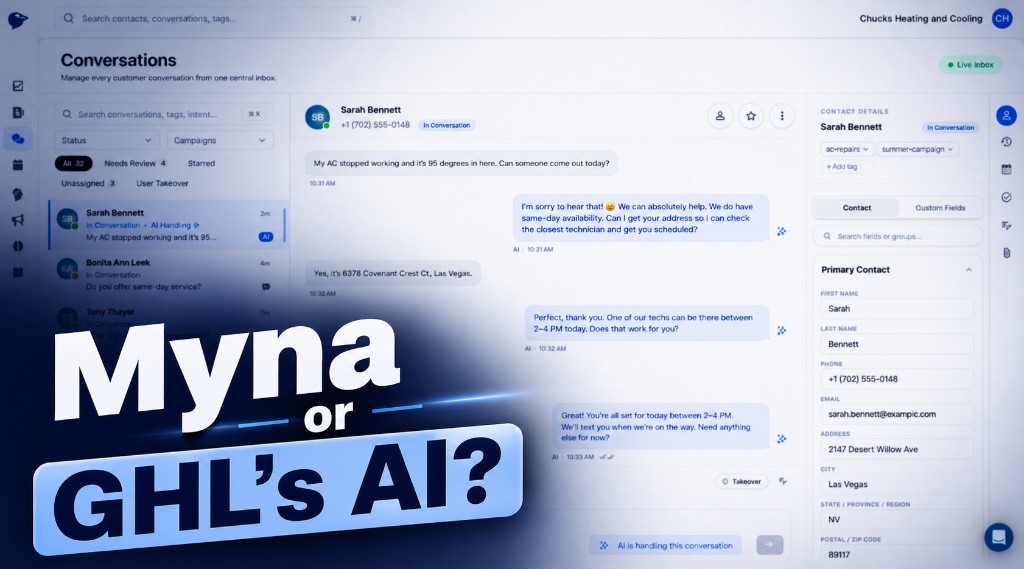
The client sees it working. An agent that answers every lead in seconds, qualifies them, and drops booked appointments onto the calendar produces a result the client can watch happen daily. When the value is visible, the invoice survives budget reviews. Contrast that with a retainer for “management” or “optimization,” where the client can never quite tell what they are paying for.
It runs without your team babysitting it. Once the agent is set up, it works without you touching every conversation. That is the difference between recurring revenue and a subscription-shaped retainer. Your MRR is not limited by how many hours you have, because delivering it next month does not require the same manual effort as delivering a service retainer.
Usage compounds. Every conversation the agent runs is billable activity. As a client’s lead volume grows, so does the usage underneath the account. You do not need to renegotiate every time volume increases.
It is cancel-resistant. A client can talk themselves out of a vague retainer. It is much harder to cancel the system that is booking appointments, because cancelling it means going back to missing leads. The structural reasons a human cannot cover the same hours and volume are the same reasons the client cannot easily replace the agent once it is running.
What Myna turns into the agency product
The difference between “we added AI texting” and “we built recurring MRR” is the operating layer behind it.
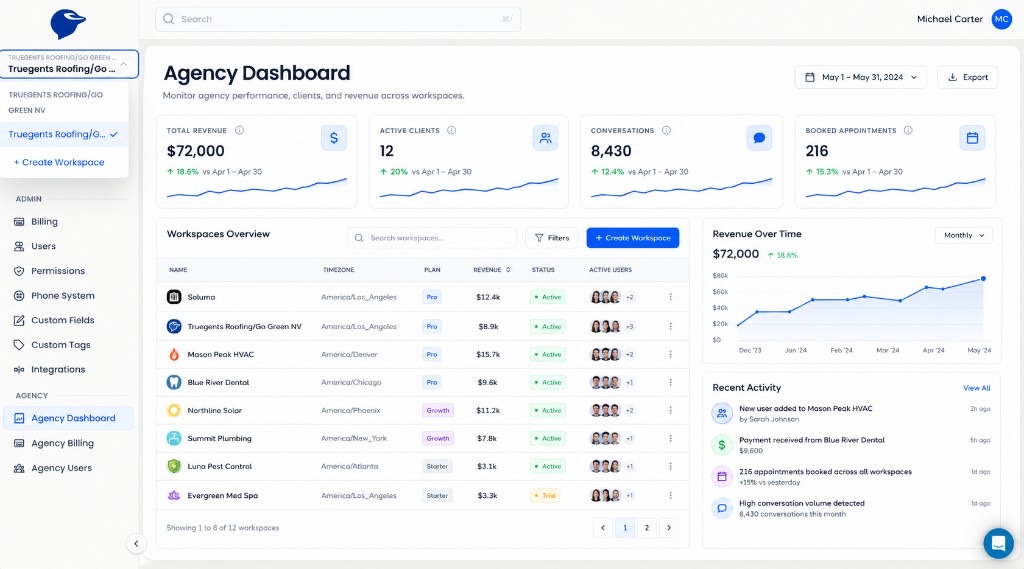
Myna’s agency plan gives you that operating layer. It is not just an agent inside one client account. It is a multi-tenant agency dashboard where you can manage client workspaces, watch performance, track conversations, see booked appointments, manage billing, and control the branded experience from one place.
That matters because recurring revenue needs proof.
If a client asks what they are paying for, you should not be digging through message logs or exporting a CRM report. You should be able to show the account: conversations handled, appointments booked, recent activity, response volume, active workspace status, and where the value is coming from.
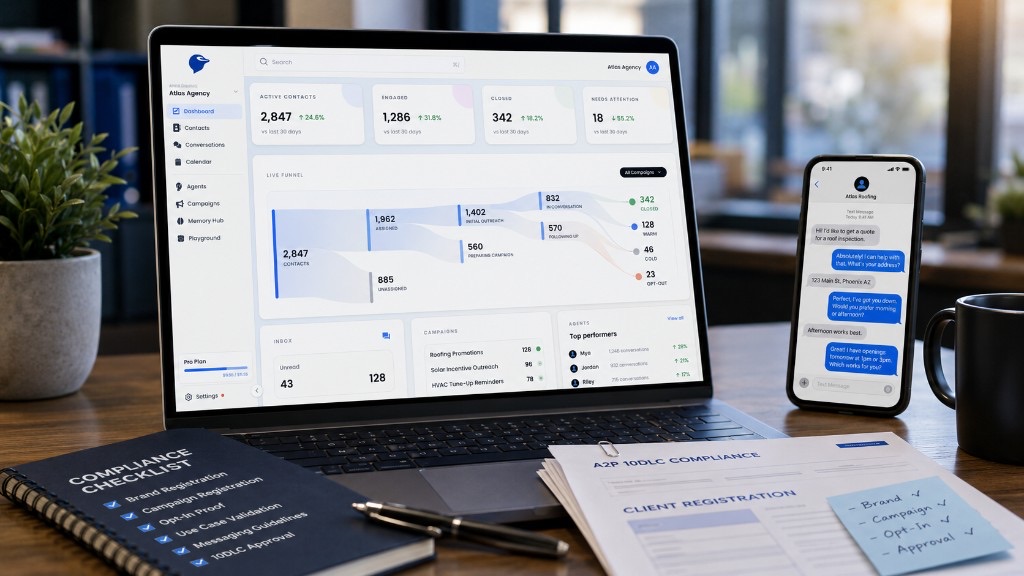
Myna gives agencies that real tracking layer. You can see active clients, conversation volume, booked appointments, revenue signals, and account activity across workspaces. That turns SMS automation from a black-box add-on into a product with measurable output.
And because each client has their own workspace, their own phone setup, tags, fields, agent behavior, integrations, and business context, you can scale without flattening every client into the same template. A roofing company, HVAC company, med spa, and dental office should not all qualify leads the same way. Multi-tenancy is what keeps those differences manageable.
White-labeling is what makes it yours
If the client experiences the product as a third-party tool, the agency owns less of the value.
That is why white-labeling matters.
With Myna, the agency plan is built so the client experience can feel like your software: your logo, your white-label domain, your branded workspace structure, your billing relationship, your users and permissions, and your reporting. The client is not buying “some AI texting vendor.” They are buying your SMS automation product.
That changes the relationship.
You are no longer just the agency that runs ads or manages a CRM. You are the company that provides the lead response infrastructure. You own the layer that answers leads, keeps conversations moving, and books appointments.
That is much harder to replace.
The four ways to price it
This is where most agencies leave money on the table, by picking one model when a blend usually wins.
Flat recurring tier. A fixed monthly price for the agent, billed like a subscription to your software. Simple, predictable, easy for the client to understand, and easy for you to forecast. The downside is that it does not capture upside when a client’s volume grows. Best as your base layer.
Usage rebilling. You mark up per-message or usage cost and keep margin on the activity the agent generates. If you run on GoHighLevel, this matches the rebilling motion you may already know through SaaS Mode. Inside Myna, the agency plan gives you the client and workspace visibility to manage this as part of the product instead of treating usage like a messy backend cost. Usage rebilling scales automatically with volume, but on its own it can be thin and unpredictable. Best as a margin layer underneath a fixed fee. We covered the broader mechanics in white-label SMS automation for GoHighLevel agencies.
Hybrid. A fixed monthly tier plus usage rebilling on top. This is the model most agencies should default to. You get predictable base MRR you can forecast, and you capture upside as the client’s volume grows. The base makes the revenue stable. The usage makes it expand. For the cost side of that model, read what an AI appointment setter actually costs.
Performance-based. You charge per booked appointment or per qualified lead. This aligns your incentives with the client and is easy to sell because you charge when you produce a result. The catch is variability: your revenue swings with performance, and you carry more risk. Some agencies use it as an entry offer to land skeptical clients, then transition to hybrid once the results are proven.
The mistake is treating these as either-or. The strongest setups stack a flat base, usage rebilling underneath, and sometimes a performance component on top for clients who need proof before they commit.
Why this revenue actually stays
Recurring revenue only matters if it recurs.
A retainer technically recurs too, right up until it does not.
SMS automation churns less because of what the client is actually paying for. When budgets tighten, clients cut the things they cannot directly tie to revenue. A vague monthly service is the first casualty. But an agent that visibly books appointments is tied to revenue by definition, and cutting it means the bookings stop.
You have moved from the “nice to have” column to the “this is how we get customers” column.
That column does not get cut as easily.
This is where Myna’s tracking matters again. If the client can see the real conversations and booked appointments, retention is no longer based on belief. It is based on proof.
Lower churn is worth more than it sounds because in a recurring model every point of churn you avoid compounds. Retained clients stack on top of new ones instead of replacing them.
That is the difference between an agency that grows and one that runs to stand still.
How to move an existing client onto it
You do not need new clients to start building MRR. You have a book of retainer clients right now, and the cleanest first move is to convert one.
Pick a client who is already getting leads from your work but visibly struggling to respond to them fast. You have probably watched their leads go cold. Offer to add lead response and booking as a new line on top of what you already do, framed as fixing a specific leak: the leads they are paying you to generate that never get answered.
Because the after-hours and speed-to-lead gap is concrete, this is an easy conversation. You are not upselling a vague add-on. You are offering to stop a loss they can see once you point at it.
Start that first client on a hybrid or even a performance model so the risk is low, prove the bookings, then use that result to move the next client. One converted client becomes your case for the rest of the book, and each one adds to your base instead of resetting it.
Myna makes that motion easier because you can build the client workspace, brand the experience, track performance, manage access, and show results from the same agency dashboard.
What this does to the agency itself
There is a longer-term reason to care beyond monthly cash flow.
Recurring revenue changes what your agency is worth.
Project and retainer revenue is barely valued when an agency changes hands, because it walks out the door with the relationships. Recurring revenue, especially low-churn recurring revenue tied to a product clients depend on, is valued very differently.
Building an MRR base does not just stabilize this quarter. It turns the agency from a book of cancellable relationships into an asset with more enterprise value.
That shift, from selling your time to owning recurring revenue, is the whole reason the SaaS model beats the service model. SMS automation is one of the most direct ways to get there because the client understands the outcome immediately: answered leads and booked appointments.
What to do this week
Do not overhaul everything.
Pick one pricing model. Hybrid is the safest default: fixed monthly tier plus usage rebilling. Then package one offer: instant lead response, qualification, and booking, billed as a recurring product on top of what the client already runs.
Set it up in a way you can prove. Branded workspace. Real conversation tracking. Booked appointment reporting. Clear usage. Client access. White-label domain and logo. Rebilling rules that make sense before the invoice goes out.
Then move one existing client onto it, ideally one whose leads you have watched go cold, and let the bookings make your case for the next.
The leads are already being generated. Turning response into a recurring product is how you stop resetting to zero every month.
Myna is built to be that product: an agency-plan SMS automation layer with multi-tenant workspaces, white-label branding, real tracking, rebilling support, and appointment-booking agents that run on top of the CRM your clients already use.
Related reading
- White-Label SMS Automation for GoHighLevel Agencies
- AI Appointment Setter vs. Human Appointment Setter
- How Much Does an AI Appointment Setter Cost?
- Why Businesses Lose Leads After 5 PM
- A2P 10DLC Compliance for Agencies, Explained