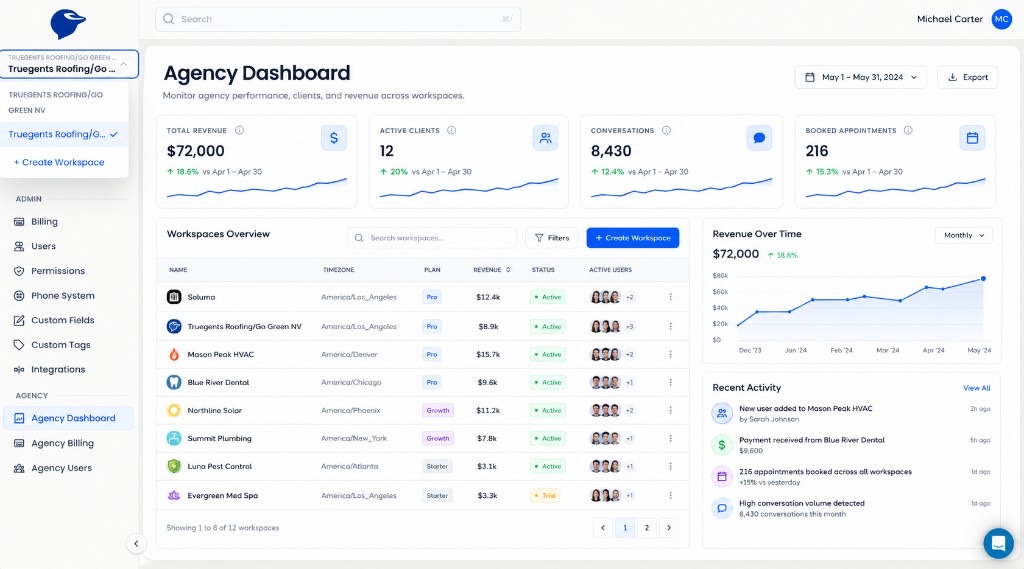
TL;DR: If you run a GoHighLevel agency, you have already turned the platform into your own branded software and rebill usage for margin. The problem is that every other GHL agency can resell the same underlying platform. Platform access alone is a commodity. The differentiation and margin live in what you layer on top. Myna gives agencies that layer: a white-label, multi-tenant SMS automation dashboard with client workspaces, analytics, conversation tracking, appointment reporting, rebilling controls, custom domains, and branded logos. It runs alongside GoHighLevel, syncs with the CRM and calendar you already use, and does not replace any of it.
You already did the hard part.
You took GoHighLevel, stripped the branding, put your logo on it, connected Stripe, and turned it into software your clients think you built. You flipped on SaaS Mode, configured plans, and started rebilling usage with a markup. When a client sends an SMS or uses a billable service, you recover the cost and can keep the spread.
Done at scale, that is real recurring margin for work you already automated.
Myna extends that same logic to the conversation layer. Instead of selling “access to a CRM,” you sell the thing clients actually notice: every lead gets answered, every conversation is visible, every booked appointment is attributable, and every client lives inside a branded workspace your agency controls.
So here is the uncomfortable question: what actually stops a client from leaving?
Because the platform underneath you is the same one thousands of other agencies resell. Same CRM. Same funnels. Same calendar. You branded it well, but if a client figures out they can get the same underlying tool from another agency, the thing keeping them is not the platform. It is the layer you added on top.
For most agencies, that layer is thin. A few workflows. A nice onboarding. Maybe a snapshot.
That is not sticky enough.
The margin and the moat are in the same place: what you build on top of the platform, not the platform itself.
Why the conversation is the layer worth owning
Of everything you can add on top of GoHighLevel, the automated conversation is one of the highest-leverage layers for three reasons.
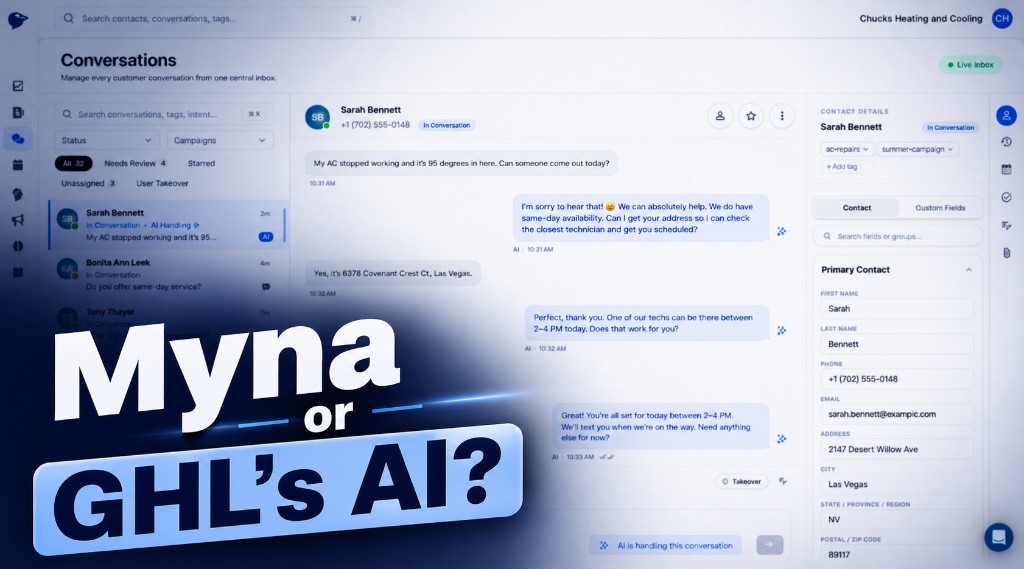
It is the part the client actually feels. Your client does not wake up excited about their CRM schema. They care about whether jobs got booked. An SMS agent that answers every lead in seconds, qualifies them, and drops booked appointments on the calendar is the part of your service the client can see working every single day. That visibility is what makes them keep paying.
It rebills cleanly. SMS is usage-based, which is exactly what GoHighLevel’s rebilling model was built to support. Every conversation your agent runs creates billable usage you can price into the service, on top of whatever you charge for the capability itself. You are not trading more of your hours for it. The cost and revenue scale with the client’s volume.
It is sticky in a way workflows are not. A client can look at a workflow and think they could rebuild it. They cannot as easily walk away from a conversational agent tuned to their business, trained on their offers, handling hundreds of live conversations a month, and booking real revenue. The deeper the agent is embedded in their day-to-day bookings, the more expensive it is for them to leave.
That is the moat you actually want.
This sits on top of GoHighLevel
The architecture matters, because this only works if it strengthens your GHL setup instead of fighting it.
GoHighLevel is the foundation. It holds the contacts, pipeline, calendar, billing, and client workspace. That is exactly where it should be. A white-label conversational agent layers on top: it plugs into the CRM, watches for new leads, runs the two-way SMS conversation, and writes the booked appointment back into the calendar.
The client’s data stays in GoHighLevel. Your rebilling stays in GoHighLevel. Nothing gets ripped out.
What you are adding is depth on the one thing that is hardest to do well: the conversation itself. Some agencies are happy with a lighter touch. Others have clients who need a genuinely customized agent: a specific personality that matches the brand, multi-step qualification for the trade, and follow-up that reactivates old leads sitting in the database.
That depth of conversational control is the thing worth white-labeling as a premium tier. It is purpose-built to run alongside GoHighLevel, not instead of it.
If you are comparing options for that layer, we broke down the best conversational AI for small businesses and how different tools fit different workflows. If you are still deciding whether a client needs GHL underneath the AI at all, read Do You Need GoHighLevel to Use an AI Appointment Setter?.
What Myna gives the agency
This is where Myna is different from a generic AI texting tool.
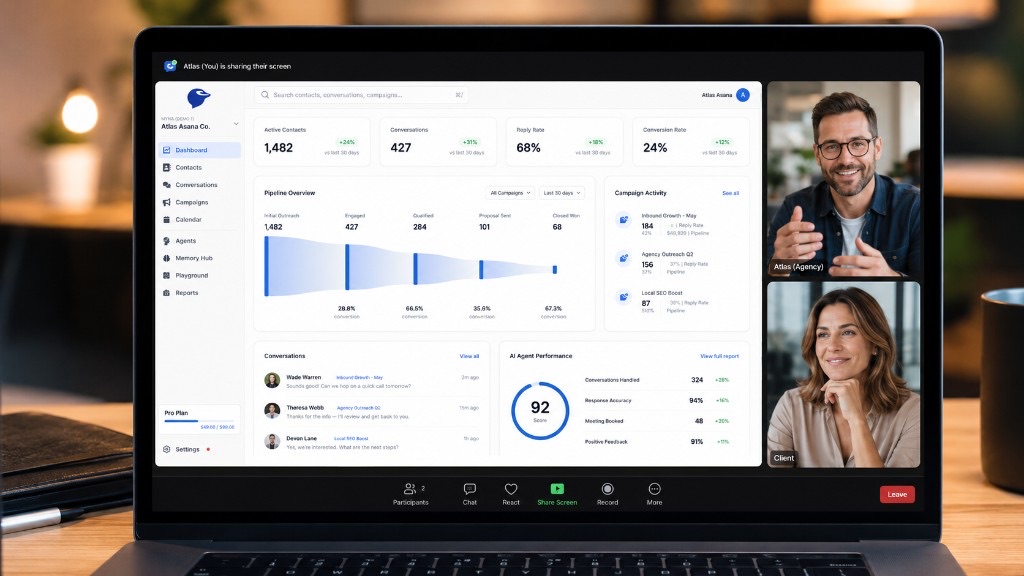
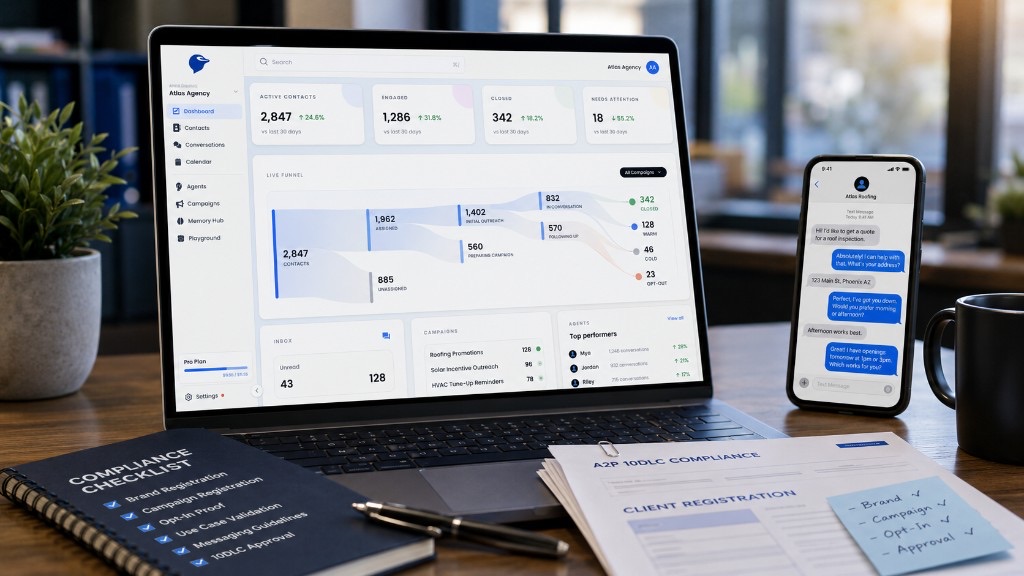
Myna gives the agency an actual command center for running SMS automation across a client base. From the agency dashboard, you can monitor revenue, active clients, conversation volume, and booked appointments across workspaces. You are not guessing which accounts are getting value. You can see which clients are active, which agents are producing conversations, and where appointments are being booked.
That matters because agencies need two views at the same time. The client needs a simple experience where their leads get answered and their calendar fills up. The agency needs the operating layer behind it: analytics, workspace management, billing, user access, phone setup, custom fields, tags, and integrations across multiple accounts.
Myna is built for that multi-tenant reality.
Each client can live in its own workspace with its own agent, lead sources, phone number, calendar, tags, and business context. Your HVAC client should not share the same setup as your dental client. Your roofing client should not have the same qualification path as your med spa client. Multi-tenancy is what lets you manage those differences without turning your agency into a spreadsheet and Zapier support desk.
The dashboard also gives you the proof you need to retain accounts. If a client asks what the automation is doing, you can point to conversations handled, appointments booked, response volume, and recent activity. That is the difference between selling a vague AI add-on and selling a measurable revenue layer.
White-label means more than hiding a logo
White-label is not just “remove Myna’s logo and call it a day.”
For agencies, white-label has to cover the full client experience. Your logo should be in the product. Your domain should be the domain clients log into. Your billing should feel like it comes from your company. Your client should experience the agent, dashboard, phone setup, and reporting as part of the software relationship they already have with you.
That is why the agency controls matter: custom logo, white-label domain, branded client workspaces, managed users and permissions, and billing/rebilling flows that let the agency package the tool as its own premium tier. The client is not buying “some AI texting vendor.” They are buying your platform with an AI conversation layer inside it.
This is also what makes the offer harder to replace. A client can compare two agencies selling the same CRM. It is much harder to compare a branded system that has their phone number, tags, lead routing, agent personality, booking behavior, analytics history, and billing already running inside it.
Rebilling becomes a product, not an admin task
The agencies that win with white-label SMS automation do not treat billing as an afterthought. They make it part of the offer.
Myna gives you the layer to manage the client relationship around usage: who is active, what workspaces are live, where conversation volume is coming from, and how the account is performing. That lets you package SMS automation as a premium plan instead of apologizing for usage costs every month.
There are a few clean ways to sell it.
You can bundle a base amount of conversation volume into a higher monthly plan. You can charge a platform fee plus usage. You can create a premium “AI booking” tier for clients who want instant lead response, follow-up, and appointment setting. The exact packaging is up to the agency, but the important point is that the client is paying for an outcome they understand: more conversations handled and more appointments booked.
The dashboard is what makes that sellable. When you can show active clients, conversations, booked appointments, revenue, and recent activity from one place, rebilling stops feeling like a hidden fee and starts looking like infrastructure for growth.
One thing you cannot skip: SMS compliance
Before you sell SMS automation to a single client, there is a hard requirement that trips up a lot of agencies: A2P 10DLC registration.
In the US, application-to-person SMS traffic sent over 10-digit long codes must be registered. The brand and campaign need to go through A2P 10DLC registration before carriers will reliably deliver messages. Skip it and the carrier ecosystem can filter or block your client’s texts, which means the agent you just sold may quietly fail to reach people.
For an agency onboarding client after client, doing this by hand for every account becomes a real operational drag.
This is worth calling out because it is exactly the kind of thing a strong white-label conversational layer should handle through onboarding, with compliance built in instead of left as a manual chore you repeat per client. When you evaluate what to put on top of GoHighLevel, treat embedded A2P 10DLC handling as a requirement, not a nice-to-have.
It is the difference between a texting product that delivers and one that silently does not. For more detail, read our guide to what 10DLC is and why it matters.
The margin math
Here is roughly how the numbers stack, kept deliberately conservative.
You may already be rebilling SMS and other usage through SaaS Mode. That is your first margin line, and it grows with every active account using the system. A two-way agent tends to create more usage than a client texting manually, because it responds quickly, follows up consistently, and keeps conversations alive.
On top of that, the conversational agent is its own premium tier.
You are not charging for “SMS credits.” You are charging for booked appointments. You are charging for a system that answers leads at 9 PM when the client is asleep. That is worth a real monthly number per client, layered on top of the base platform fee.
Add even a modest premium tier across a book of clients and it compounds fast. The reason this works is the same reason the SaaS model beats the retainer model in the first place: you are charging for access to something that runs itself, not for more hours from your team.
The Myna agency dashboard turns that into something you can manage instead of something you have to manually reconcile. You can see clients, usage signals, appointment outcomes, and account activity across workspaces. That gives you a cleaner way to defend the premium tier: not “trust us, AI is working,” but “here are the conversations, here are the booked appointments, here is the account activity.”
The conversational agent is one of the highest-value things you can put behind that access. For a fuller picture of the underlying capability costs, here is what an AI appointment setter actually costs once every input is counted.
What to actually look for
Not every SMS tool is worth white-labeling.
A one-way blaster that fires the same message to a list is not the same product as an agent that holds a real conversation, and the difference between broadcasting and converting is the whole game.
When you choose the layer to put on top of GoHighLevel, the checklist is short.
It should connect cleanly to GoHighLevel, read new leads, and write booked appointments back to the calendar. It should let you customize the agent deeply enough to match each client’s brand and trade, not just swap a name into a template. It should handle A2P 10DLC compliance so you are not registering brands by hand forever. It should be genuinely white-label, so the client experiences it as part of your software rather than a third-party bolt-on.
And for an agency, it should have an agency dashboard. That means multi-tenant workspaces, analytics, client management, billing and rebilling controls, white-label domain support, custom logo branding, user permissions, phone system setup, custom fields, custom tags, and integrations you can manage centrally.
Most importantly, it should hold a real two-way conversation. A human setter cannot cover every hour and every spike in volume, and a one-way blast cannot book the job. We covered that in the AI appointment setter versus human appointment setter comparison.
Get those right and you have added the one layer that makes your GoHighLevel offer both more profitable and harder to leave.
Where to start
You do not need to rebuild your agency. You need to add one tier.
Take your existing GoHighLevel SaaS offer and put a conversational agent on top of it as a premium plan: instant lead response, qualification, and booking, running on the CRM your clients already live in, rebilled through the billing setup you already use.
Then brand the client experience: your logo, your domain, your workspace structure, your billing, your reporting. Give each client a clean place to see the value while you manage the entire book from the agency dashboard.
The platform made you look like a software company. The conversation is what makes clients stay.
Myna is built to be that layer: connected to GoHighLevel, white-labeled as yours, with multi-tenant workspaces, analytics, rebilling support, custom domains, logo branding, and compliance handled, so you can sell it as your own product from day one.
Related reading
- Best Conversational AI for Small Businesses in 2026
- Do You Need GoHighLevel to Use an AI Appointment Setter?
- How Much Does an AI Appointment Setter Cost?
- AI Appointment Setter vs. Human Appointment Setter
- What Is an SMS Blaster?
- What Is 10DLC?