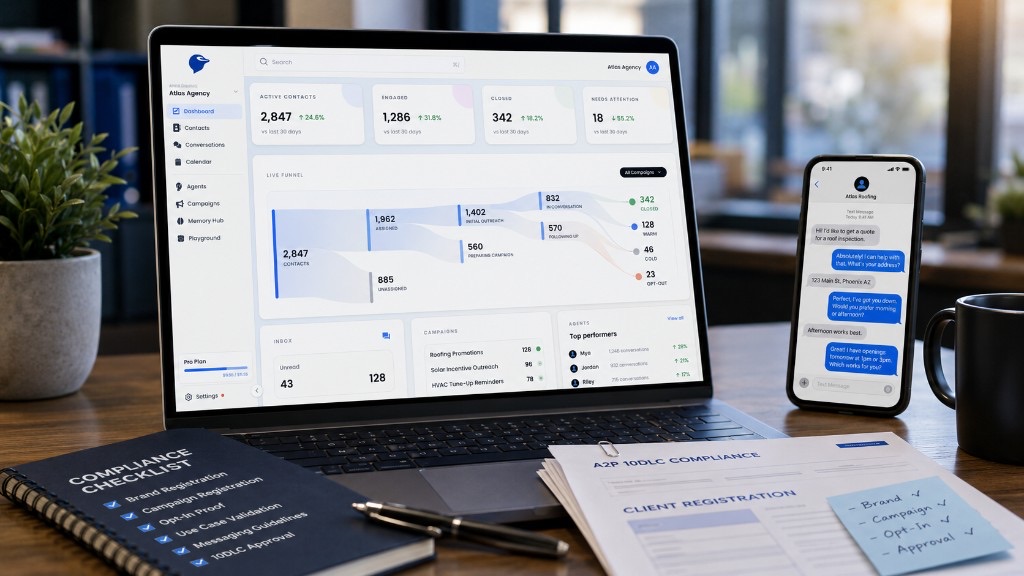
TL;DR: A2P 10DLC is the carrier registration that decides whether the SMS you sell to clients actually reaches phones. It has two core parts: brand and campaign, filed through The Campaign Registry via your messaging provider, and it applies to every business texting US numbers through software, not just marketing texts. For agencies, the problem is not understanding it once. It is registering it per client, every onboarding. The newer rules trip up agencies specifically: reseller ID requirements when registering on behalf of a client, newly issued EIN risk, strict opt-in proof, and tighter use-case adherence. Skip any of it and your client’s texts can get filtered while you keep billing for a product that is not delivering.
Most agencies treat A2P 10DLC like paperwork.
Something to click through once and forget.
That is exactly why so many of them are quietly selling SMS that does not get delivered.
Here is the part nobody tells you plainly: 10DLC registration is not a formality. It is the switch that decides whether a carrier lets your client’s messages through or filters them. Get it right and texts land. Get it wrong, or skip it, and the messages can disappear into carrier filtering with no useful signal the client sees.
The agent you built is running. The client is being billed. The leads on the other end are getting silence.
For an agency onboarding client after client, this is not a one-time chore. It is a recurring requirement on every account you launch, and the rules have gotten stricter. So it is worth understanding properly, because it sits directly between the product you sold and the result the client is paying for.
What A2P 10DLC actually is
Strip out the jargon.
A2P means application-to-person: any text sent by software rather than typed by a human on a phone. Your CRM, an automation, an AI agent, a reminder workflow, a lead follow-up sequence.
10DLC means 10-digit long code: the standard local phone number format businesses use to text customers.
Put them together and A2P 10DLC is business texting from a normal local number, done the way US carriers require.
The carriers built a registration system, run through The Campaign Registry and messaging providers, to cut down on spam and make business texting more accountable. You register two things.
First, who the business is: the brand, tied to a legal entity and tax ID. That is brand registration.
Second, what the business is going to send: the use case, message examples, opt-in flow, opt-out handling, and supporting URLs. That is campaign registration.
Once both are approved, the numbers tied to that campaign are cleared to send under that use case.
The single most misunderstood point is this: A2P 10DLC applies to business texting broadly, not just obvious promotions. Appointment reminders count. Lead reactivation counts. A two-way qualification conversation counts. If software is texting a US number on behalf of a business, it needs to be registered.
There is no “we only send helpful reminders” exemption.
Why this is an agency problem
If you ran one business, you would register once and move on.
Agencies do not run one business. You run one per client, and each one is its own brand with its own campaign.
That means 10DLC is a per-client operational requirement on every onboarding. Every new client needs their legal entity registered as a brand, their use case registered as a campaign, and their opt-in process documented well enough to pass review.
Multiply that across a growing book and it becomes real operational load. It either slows onboarding to a crawl or gets rushed and skipped, which is how you end up with clients whose texts do not deliver.
The agency-specific issue is on-behalf registration. If you register campaigns for client businesses, the submission has to correctly reflect that you are a platform, agency, or reseller acting on behalf of the end business. You generally cannot register everything under your own umbrella and pretend the messages are yours when the actual sender is the client.
That is where reseller ID requirements come in. Providers have been tightening this because the carrier ecosystem wants to know the actual business behind the messages and the platform relationship behind the registration. Get that wrong and you risk rejections, locked campaign data, or disruption across accounts.
The traps that get agencies rejected
Most 10DLC guides online describe the easy version. Here is what actually gets agencies rejected or slowed down.
Missing or incorrect reseller information. If you are registering campaigns on behalf of another legal entity, make sure the reseller relationship is represented correctly through your provider. Vonage’s 2025 update is a useful example of how seriously providers are treating reseller designation: once reseller data is attached to a campaign, it cannot simply be removed later.
Bad business identity data. The legal business name needs to match tax records. A DUNS number is not a replacement for an EIN for US Standard Brand registration. HighLevel’s own best practices call this out directly: US-based standard brands need a valid EIN, and using a DUNS number can leave the brand unverified.
New EIN timing. Newly issued EINs can fail verification because they have not propagated into the systems The Campaign Registry uses. HighLevel warns that EINs registered in the last 15 days may be rejected, and its broader best-practices guidance notes that very new EINs can take longer to become verifiable. If a client formed their LLC last week, do not promise a clean go-live date before you know the EIN is usable.
Opt-in proof. This is where most rejections happen. Carriers want to see how recipients agreed to be texted. The opt-in URL needs to be live and publicly accessible. The consent language needs to be clear. The checkbox should not be pre-checked. SMS consent should not be forced as a condition of submitting a general form. Privacy Policy and Terms links need to exist and be reachable.
Use-case drift. You register a campaign for a stated purpose, such as lead follow-up and appointment booking. If the messages start drifting into unregistered promotions, unrelated offers, or vague blasts, you risk filtering or suspension. This matters more with AI-driven texting because an agent that is not tightly scoped can wander. The fix is to design the agent to stay inside the registered use case.
Opt-outs and records. STOP needs to stop the messages. No delay, no manual handoff, no “we will remove you soon.” Some state laws add their own requirements on top. Virginia’s updated Telephone Privacy Protection Act, effective January 1, 2026, says text-message solicitation opt-outs using STOP or UNSUBSCRIBE must be honored for at least 10 years. If your texting layer does not handle opt-outs automatically and preserve the record, that is a liability sitting on every client account.
The timeline will eat onboarding
Plan for this early.
Brand approval can be quick when the business data is clean. Campaign review is the slower part, and timelines vary by provider, use case, queue volume, and whether the submission gets rejected. Some applications clear quickly. Others stretch into one to four weeks when the campaign is more complex or the review queue is backed up.
Every rejection sends you back into the process.
So a sloppy application does not cost you one resubmission. It can cost you another week or two of client expectation management.
For an agency, that means 10DLC registration has to start on day one of onboarding, in parallel with everything else, not as the last step before go-live. If you promise a client they will be texting leads next week and you have not started registration, the registration queue alone can make that promise impossible.
What it costs
The fees are usually smaller than the operational cost, but you should know them so you can price correctly.
Expect brand registration fees, campaign fees, recurring monthly campaign fees, and carrier surcharges. Exact amounts vary by provider, brand type, use case, vetting, and pass-through structure. Standard brands with an EIN usually get more capacity and use-case flexibility than sole proprietor brands, so the path a client takes affects both cost and throughput.
If you run clients through GoHighLevel, treat these fees as infrastructure costs of doing SMS correctly. They are not the place to make margin. The margin lives in rebillable usage and the white-label conversational layer on top.
Compliance is also one of the line items people forget when they estimate what an AI appointment setter actually costs. The tool is not the whole cost. Messaging, registration, carrier fees, and operational setup all matter.
Where this breaks at scale
Any single client’s registration is manageable.
The problem is the aggregate.
Across a growing book, you are tracking dozens of brands and campaigns, keeping every opt-in URL live, watching for use-case drift on every automated conversation, handling opt-outs and their record retention, and starting each new registration early enough that it clears before launch.
Done by hand, per client, this is where agencies either slow down or start cutting corners.
The agencies that scale cleanly treat compliance as infrastructure, not admin. The texting layer you run on top of your CRM should handle registration as part of onboarding, keep the agent’s messages inside the registered use case, and process opt-outs automatically.
The distinction matters. A one-way SMS blaster that fires the same message to a list makes drift and opt-out handling entirely your problem. A purpose-built conversational AI layer can be designed to stay compliant by construction.
When compliance is built into the layer, it stops being a per-client tax and becomes a repeatable step.
What to do
Do three things.
Build 10DLC registration into onboarding as a fixed, day-one step, not a scramble before launch.
Choose a conversational layer that handles registration, use-case scoping, and opt-outs so compliance does not scale linearly with your client count.
Never sell a client SMS you have not registered, because unregistered texting is not a smaller version of the product. It is a product that may silently fail.
Compliance is not the exciting part of the pitch. But it is the part that determines whether everything else you sold actually reaches a phone.
Myna is built to handle A2P 10DLC as part of onboarding, keep conversations inside their registered use case, and manage opt-outs automatically, so the compliance layer scales with you instead of against you.
Related reading
- What Is 10DLC and Why Does It Matter for Your Business?
- White-Label SMS Automation for GoHighLevel Agencies
- What Is an SMS Blaster?
- Best Conversational AI for Small Businesses in 2026
- How Much Does an AI Appointment Setter Cost?
References
- HighLevel Support - A2P Standard Brand Registration Guide for 10DLC
- HighLevel Support - A2P 10DLC Brand Approval Best Practices
- Twilio - Programmable Messaging and A2P 10DLC
- Twilio - A2P 10DLC Required Business Information
- Vonage API Support - 10DLC Reseller ID Requirements
- Virginia Code - Section 59.1-514, Unwanted Telephone Solicitations