



TL;DR: The best conversational AI for a small business depends on the workflow: support, reviews, eCommerce, lead follow-up, or appointment booking. Podium, Zendesk, Intercom, GoHighLevel, Gorgias, and Lindy all fit specific use cases, but Myna is the most direct fit for service businesses that need affordable SMS lead qualification and appointment booking without enterprise complexity.
The conversational AI market has gotten crowded fast. Two years ago there were maybe a handful of tools worth considering. Now there are dozens, and most of them are either built for enterprise companies with dedicated IT teams, laser-focused on one specific industry, or general-purpose tools that require significant setup before they do anything useful.
For small businesses, this is a real problem. You don’t have a technical team. You don’t have time to stitch together three platforms. You need something that works, handles real customer conversations, and doesn’t require a $500/month commitment before you’ve seen a single result.
This list covers the tools that actually come up in serious conversations about conversational AI for small businesses in 2026 — what they’re good at, who they’re built for, and where they fall short.
What “Conversational AI” Actually Means in This Context
Before getting into the tools: conversational AI for small businesses covers a wide range of use cases, and the right tool depends almost entirely on what problem you’re trying to solve.
Customer support — answering questions, handling tickets, resolving complaints — is a different problem than lead qualification and appointment booking. eCommerce returns are a different problem than following up on a roofing estimate request. The tools that are best for one use case are often mediocre or completely wrong for another.
Read the use case descriptions for each tool carefully. The biggest mistake small businesses make when evaluating conversational AI is choosing a tool built for a completely different workflow.
1. Podium
Best for: Local businesses focused on reviews and reputation management
Podium started as a review generation platform and has expanded into messaging and AI over time. The AI receptionist product can handle inbound texts, answer common questions, and collect information from customers.
For businesses where the primary goal is getting Google reviews and managing customer communication in one inbox, Podium is a reasonable choice. It’s well-built, has a clean interface, and has been around long enough to have worked out most of the early bugs.
The limitations are real though. Pricing starts at $799 per month, which is a steep commitment for a small business before you’ve proven any ROI from the tool. The AI features feel like an addition to the core product rather than the core product itself. And for businesses that need proactive outbound outreach — following up on leads, reactivating old contacts, running qualification sequences — Podium isn’t really designed for that. It’s better at receiving conversations than starting them.
Verdict: Good fit if reviews and inbound messaging are your primary need. Less useful if you’re trying to automate outbound lead follow-up.
2. Zendesk AI
Best for: Businesses with high-volume customer support operations
Zendesk has been the dominant name in customer support software for over a decade, and their AI layer, built around their Fin product and native automation, is genuinely capable. It can resolve a significant percentage of support tickets without human involvement, integrates with their full ticketing system, and has the enterprise infrastructure to handle serious volume.
For small businesses, the honest answer is that Zendesk is usually the wrong tool. It’s built for support teams, not sales or outbound communication. The setup is complex. The pricing scales quickly once you move beyond the most basic plan. And the product assumes you have a dedicated support function — someone managing the inbox, reviewing AI responses, handling escalations.
If you’re a 5-person service company that needs to follow up on leads and book appointments, Zendesk is like buying a commercial kitchen because you need to make dinner. Technically capable, deeply impractical.
Verdict: Strong product for its intended use case. That use case is not most small businesses.
3. Gorgias
Best for: eCommerce businesses on Shopify, BigCommerce, or Magento
Gorgias is the conversational AI and helpdesk platform built specifically for eCommerce. It integrates directly with Shopify and similar platforms, pulls in order data, and lets the AI handle the questions that dominate eCommerce support: where’s my order, can I return this, what’s my tracking number.
Within that use case, it’s excellent. The integrations are tight, the AI is trained on eCommerce-specific workflows, and the automation genuinely reduces support volume for online stores.
Outside of eCommerce, it’s essentially useless. There’s no meaningful use case for Gorgias if you’re not selling physical products online. It’s not built for service businesses, appointment booking, lead qualification, or anything outside its lane.
Verdict: Best-in-class for eCommerce support. Irrelevant for everyone else.
4. Intercom
Best for: SaaS companies and tech businesses with product-led growth
Intercom is one of the most mature conversational AI platforms on the market. Their Fin AI agent handles customer questions, routes conversations, and integrates with their full customer messaging suite. For SaaS companies managing onboarding, support, and retention conversations, it’s a genuinely strong product.
For small businesses outside of tech, the fit is shakier. Intercom’s pricing starts at $74 per month for basic access and climbs steeply based on seats and usage. The platform is built around a product-led model — it assumes your customers are logging into a software product, interacting with in-app messages, and having support conversations tied to their account data.
That model doesn’t translate cleanly to a contractor, a home services company, or any business where the primary customer interaction happens over SMS before a job is even booked. Intercom is excellent at what it does. What it does is serve a specific type of business.
Verdict: Worth considering if you’re running a SaaS or tech product. Hard to justify for traditional service businesses.
5. GoHighLevel Conversation AI
Best for: Marketing agencies managing multiple client accounts
GoHighLevel has built out a Conversation AI feature within their broader CRM and marketing platform. For agencies running campaigns across multiple clients, having AI-assisted conversation handling inside the same platform as their pipelines, automations, and reporting makes operational sense.
For individual small businesses, the math gets complicated fast. GoHighLevel costs $97 to $297 per month as a baseline, and that’s before the AI features, before SMS costs, and before any add-ons. The platform is also genuinely complex — it has an enormous feature set that takes time to learn, and most small businesses end up using about 20% of what they’re paying for.
Several popular AI appointment setting tools, including some heavily marketed options, are built on top of GoHighLevel rather than being standalone products. That means you’re paying for GHL plus the add-on tool, which changes the total cost of ownership significantly compared to what the add-on’s pricing page suggests.
Verdict: Makes sense for agencies. For individual small businesses, the cost and complexity are hard to justify unless you’re already deep in the GHL ecosystem.
6. Lindy
Best for: Tech-savvy users who want to build custom AI workflows
Lindy is a general-purpose AI agent builder. You can create agents for a wide range of tasks — email management, scheduling, research, customer communication — by connecting different triggers and actions. For people who are comfortable with workflow tools and want flexibility, it’s an interesting platform.
The tradeoff is that flexibility requires configuration. Lindy doesn’t come pre-built for any specific business type or use case. Getting it to do exactly what you need takes time, some technical comfort, and ongoing iteration. For small business owners who want a tool that works out of the box without a setup project, that’s a real barrier.
It’s also worth noting that Lindy is a horizontal tool — it’s not built specifically for sales, lead follow-up, or appointment booking. You can build something that handles those workflows, but you’re doing the building.
Verdict: Powerful if you’re willing to invest in setup. Not the right choice for businesses that need something working this week.
7. Myna
Best for: Service businesses that need to qualify leads and book appointments via SMS
Myna is built for a specific problem: service businesses — HVAC, roofing, solar, plumbing, electrical, contracting — that are paying for leads and losing them to slow or inconsistent follow-up.
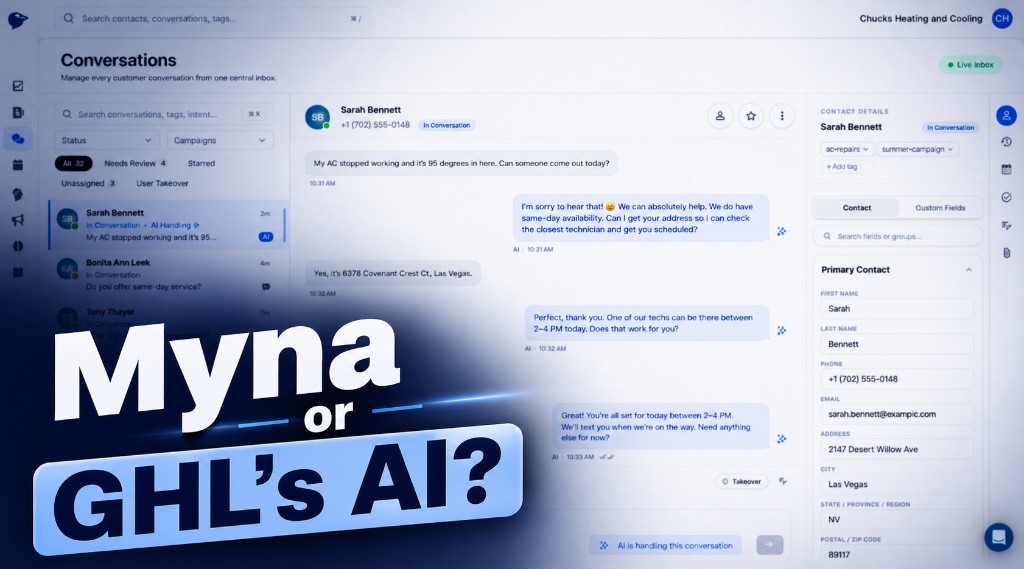
The AI agent contacts leads via SMS, carries a qualifying conversation, and books appointments directly into your calendar. It works as a standalone product with no CRM or third-party platform required. Setup takes minutes, not days.
The agent itself is where Myna separates from lighter automation tools. It uses a trained agentic decision and reasoning layer to understand context, choose the next best response, handle edge cases, and keep the cadence of the conversation feeling human. Instead of forcing every lead through the same rigid script, it can adjust based on how the person replies — short answers, objections, scheduling friction, unusual questions, or contacts who need more follow-up before they are ready to book.
Just as important: Myna does not require prompt engineering or a workflow builder before it becomes useful. Most conversational AI tools hand you a blank canvas and expect you to configure prompts, branches, rules, triggers, and fallback logic yourself. Myna is already trained and configured around real service business workflows by industry experts, so the agent is ready to deploy out of the box instead of becoming another setup project.
Pricing is straightforward. The platform is free to start, $49 per month for full access, and $99 per month for higher volume usage. Usage costs are published and passed through transparently: $0.0089 per SMS segment, $0.02 per AI-generated message, plus carrier fees. There are no platform dependencies, no bundled markups, and no surprises on the monthly invoice.
The trade-off compared to broader platforms: Myna is purpose-built, which means it’s not trying to be a full CRM, a support platform, or a general-purpose automation tool. If you need a tool to handle every customer communication function across your entire business, it may not replace everything on your stack. If you need a reliable, affordable way to stop losing leads and start booking more appointments, it’s the most direct solution on this list.
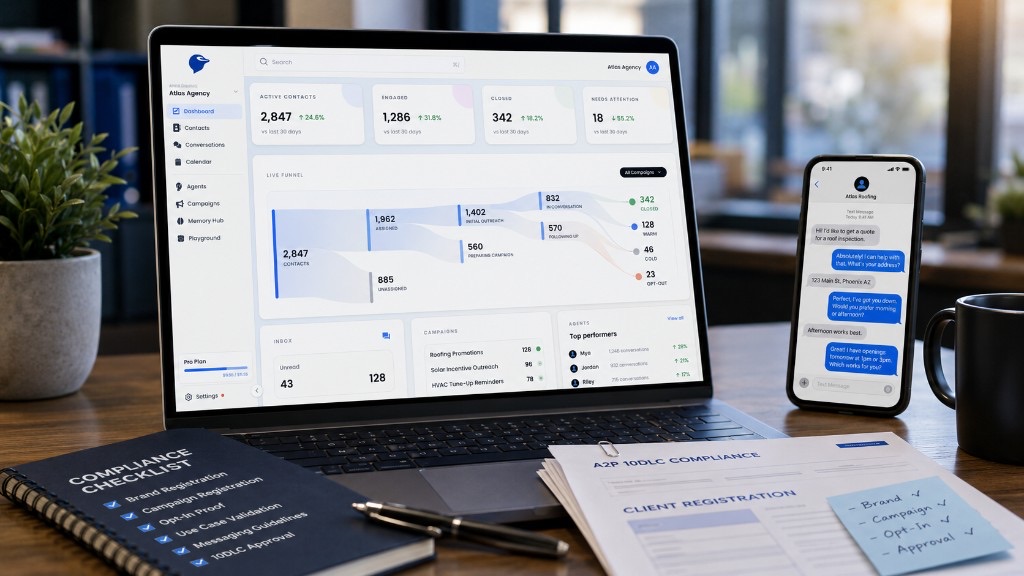
Myna is also one of the few tools in this category that handles A2P 10DLC registration natively — the compliance requirement for business SMS in the US that most platforms leave you to figure out on your own.
How to Choose the Right Tool
The decision comes down to three questions.
What is the primary job you need this AI to do? Customer support and lead conversion are different jobs. Make sure the tool you’re evaluating was built for your job, not adapted for it.
What does the total cost of ownership look like? Add up the platform fee, any infrastructure dependencies, and realistic usage costs at your expected volume. The number on the pricing page is rarely the number you’ll actually pay.
How much setup are you willing to do? Some tools work out of the box. Others require significant configuration. Be honest about how much time you have to invest before you see any results.
For most small service businesses in 2026, the answer is a purpose-built tool with transparent pricing that handles the top of the funnel — getting leads into conversations and conversations into booked appointments — without requiring a technical project to get started.
Related: