



Every tool has limits. Any platform that tells you otherwise is either lying or hasn’t been used enough to find them yet.
AI texting is genuinely useful — the response rate data, the lead conversion numbers, the after-hours coverage — all of that is real. But it works best when you understand exactly what it is, what it isn’t, and where the handoff to a human needs to happen.
Here’s the honest answer.
What AI texting is not designed to do
The biggest limitation of AI texting is also the most misunderstood one: it should not be making final transactional decisions on your behalf.
Theoretically, you could build an agent that quotes prices, processes payments, and closes deals entirely over SMS. The technology exists. But the risk is real — a misquote, an incorrect offer, a commitment made without the full context a human would have. The downside of that kind of failure in a real business is significant.
This is why we talk about the 30% rule in AI. AI handles the part of the process that doesn’t scale manually — initial response, qualification, follow-up, appointment booking. A human handles the close. That division of labor is not a limitation of the technology. It’s the right way to use it.
Can AI assist the sales process beyond booking? Yes. Should it run the whole thing independently? Not yet, and probably not for a while.
The setup dependency
AI texting performs exactly as well as what you put into it. That’s not a cop-out — it’s the most important thing to understand before you start.
An agent with a rich knowledge base, a defined personality, and thoughtful follow-up sequences will produce conversations that feel natural and convert well. An agent set up in five minutes with no backstory, no business context, and no instructions will produce hollow conversations that leads can sense aren’t real.
Myna’s Memory Hub is where you train your agent — FAQs, service area, pricing, objection handling, company background. The more you put in, the better it performs. This is not unique to Myna. Every AI system is only as good as its inputs.
The good news is that Myna is production-ready out of the box. A basic agent can be live in minutes. The ceiling, though — the difference between a decent agent and a great one — is determined by how much time you invest in training it.
Scale limits come from carriers, not the AI
One question that comes up from businesses running high-volume campaigns: does AI texting break down at scale?
The AI layer itself scales without issue. It can handle thousands of simultaneous conversations without degradation in quality. What does have limits is carrier throughput — the daily sending caps and message rates that come with A2P 10DLC registration.
These limits exist because carriers enforce them to prevent spam. They’re not arbitrary — they’re part of what makes compliant SMS campaigns actually reach people. Understanding your throughput limits and planning campaign volume around them is part of running a serious SMS operation.
Where Myna sits between chatbot and autonomous agent
Most AI tools in this space fall into one of two categories:
Sequential chatbots — rigid, step-based, follow a script. Reliable but brittle. The moment a lead goes off-script, the conversation breaks.
Fully autonomous agents — can act independently, make decisions, take actions without predefined triggers. Powerful but unpredictable. Hard to control, hard to audit, and risky to deploy in customer-facing situations.
Myna sits deliberately between these two. It’s state-aware — it knows the full context of a conversation and reasons through each response. But it’s also constrained — it only acts on predefined triggers, like a scheduled follow-up or a contact going inactive past a set threshold.
That balance is intentional. It’s what allows the agent to feel natural and adaptive without doing something unexpected that damages a customer relationship or creates a compliance issue. We’re being careful about what we deploy, and that carefulness is part of why it works.
What AI texting handles better than you’d expect
A few things that people assume are limitations but actually aren’t:
Slang, short replies, and emojis. Myna is built on an extensive language model that reads “k”, “maybe later”, ”👍”, or “lol sure” the same way a real person would. It doesn’t require grammatically correct, complete sentences to understand intent. This is a meaningful difference from older chatbot systems that needed inputs to match predefined patterns.
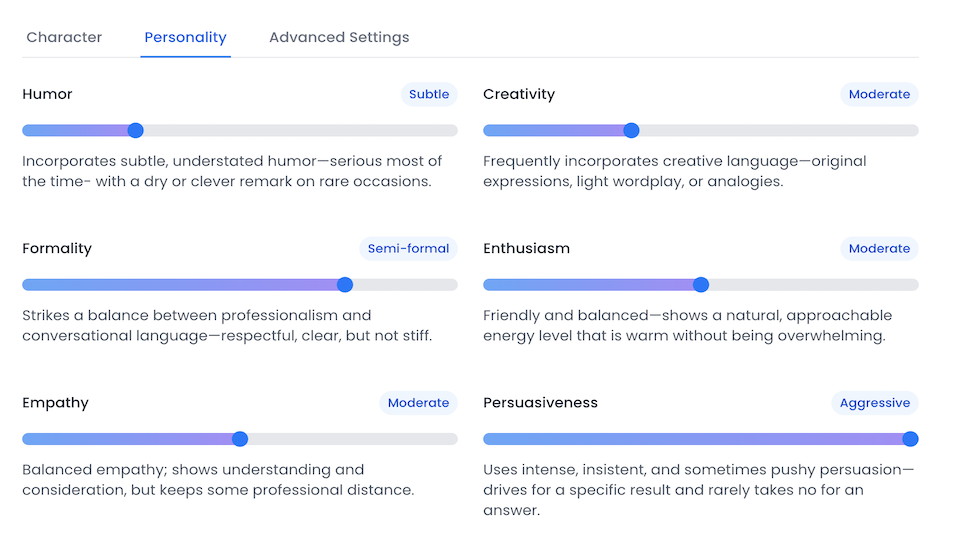
Emotional conversations. Myna’s personality builder includes an empathy setting — a slider that controls how the agent responds to frustration, hesitation, or distress. If a contact is hostile, the agent de-escalates. If the hostility continues, it opts the contact out automatically and logs the interaction. It never escalates a conflict, never snaps back, never makes things worse.
Contacts who don’t know they’re talking to AI. Will leads know? Not unless they ask directly. Most don’t ask. Many assume they’re talking to a real person. That’s by design — the goal is to simulate natural human interaction closely enough that the experience feels genuine. The agent isn’t trying to deceive anyone, but it’s also not announcing itself as a bot in every message.
What we’re actively improving
One honest limitation right now: conditional logic based on qualification answers.
Here’s a real example. We work with a commercial solar panel waste recycling company. They only serve commercial and industrial clients — residential customers are not a fit. Today, an agent can qualify a lead and gather information, but the ability to politely decline service mid-conversation based on a qualification answer — “we’re not the right fit for residential, but here’s who might be able to help” — is something we’re actively building.
This kind of conditional action will make agents significantly smarter. It’s on the roadmap. It’s not there yet.
As the platform grows, improvements like this get added based on real customer needs — not hypothetical features. That’s a deliberate approach. We only deploy what we know works.
The honest summary
AI texting has real limits. It shouldn’t close deals. It depends on quality setup. It operates within carrier throughput constraints. It can’t yet make complex mid-conversation decisions based on qualification outcomes.
What it does well — engaging leads instantly, following up consistently, qualifying contacts, booking appointments, handling slang and emotion naturally, operating 24/7 without variance — covers the exact gap that costs most service businesses jobs every week.
The contractors getting the best results aren’t expecting AI to do everything. They’re using it to fix one specific breakdown in their process and keeping humans involved everywhere else. That combination is what works.
If you want to understand more about where AI fits and where it doesn’t, read What is the 30% rule in AI? and Can you use AI to send text messages?