


TL;DR: An SMS blaster sends one message to many contacts at once. It’s a broadcast tool — fast and high-reach, but one-way. It’s different from AI texting, which handles two-way conversation. Both are legitimate tools; they’re just built for different jobs.
The term gets used loosely, so it’s worth being precise about what an SMS blaster actually is and what it isn’t.
The Basic Definition
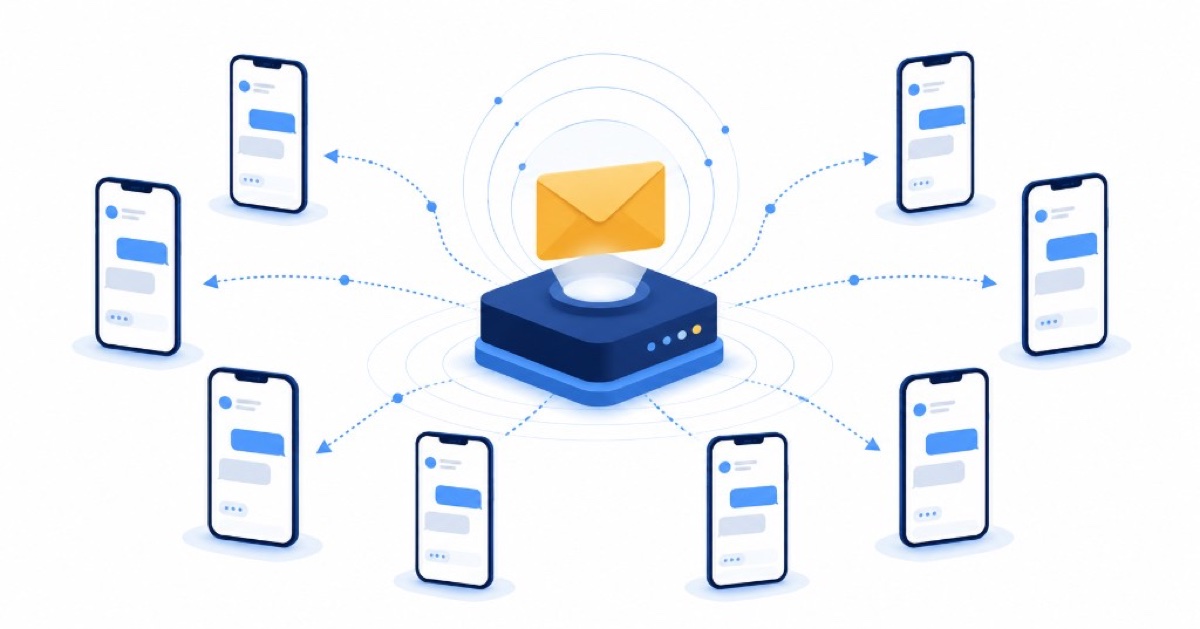
An SMS blaster — sometimes called a bulk SMS tool or mass texter — is software that sends a single pre-written message to a large list of contacts at the same time.
You write the message once. You load the list. You hit send. Everyone on the list gets it within seconds.
That’s it. The defining feature is scale and simultaneity. A message that would take a person hours to send one-by-one gets delivered to thousands of contacts in the time it takes to click a button.
How SMS Blasting Works
The mechanics are straightforward:
- You import a contact list — usually a CSV with phone numbers, sometimes with merge fields like a first name
- You write the message — typically under 160 characters to avoid splitting into multiple SMS segments, though longer messages are possible
- You schedule or send immediately — the platform queues the messages and sends them through carrier infrastructure
- Delivery reports come back — the platform logs delivered, failed, and opted-out numbers
Most blasting platforms also handle basic merge personalization (“Hi [FirstName]”), basic scheduling, and opt-out processing when someone replies STOP.
What they generally don’t do: read replies, understand context, or continue a conversation. The message goes out. Whatever happens next is up to the recipient.
What SMS Blasters Are Used For
Blasting works well for a specific set of use cases — ones where the goal is broadcasting information rather than starting a dialogue.
Promotional campaigns. A limited-time offer, a seasonal sale, a flash discount. The goal is reach: get the message in front of as many people as possible before the window closes.
Event and appointment reminders. A dentist office confirming tomorrow’s appointments. A contractor reminding a customer that a crew is arriving Thursday. These are one-way informational messages — no reply needed.
Re-engagement campaigns. A dormant contact list that hasn’t heard from you in six months. A blast announcing something new can wake up old leads. Whether those leads respond and convert is a separate problem.
Announcements. Product launches, service changes, new locations, operational updates. Anything where you’re informing your customer base rather than selling to them.
How It’s Different From Two-Way AI Texting
This is where the distinction matters most for businesses thinking about lead conversion.
An SMS blaster gets your message out. It doesn’t do anything with what comes back.
If a lead responds “How much does this cost?” or “Can I get a quote on Thursday?”, an SMS blaster has no way to handle that. The reply sits there until a human reads it — which, depending on volume and staffing, might not happen for hours.
Two-way AI texting is built for the other side of that problem. The AI sends the opening message, reads whatever comes back, and continues the conversation — answering questions, qualifying the lead, and moving toward a booked appointment. At any volume, without a human monitoring the inbox.
The two approaches aren’t mutually exclusive. Some businesses use a blast to re-engage a list and then use an AI agent to handle every reply automatically. The blast generates the responses; the AI converts them.
The Question of Legality
This is where a lot of businesses get into trouble. Sending bulk SMS sounds simple until you look at the compliance layer underneath it.
In the US, commercial mass texting is regulated under the TCPA (Telephone Consumer Protection Act) and requires A2P 10DLC carrier registration before sending at scale. The rules around opt-in consent, opt-out handling, and message content are specific — and the penalties for getting them wrong are significant.
Whether SMS blasting is legal for your specific use case depends on how your contact list was collected and how your campaigns are structured. That question has a full answer — including what the fines look like and how compliant platforms handle registration.
The Short Version
An SMS blaster is a broadcast tool. Fast, high-reach, built for one-way communication at scale. It’s the right tool when you want to get a message to a lot of people simultaneously — reminders, promotions, re-engagement campaigns.
It’s not designed to handle what happens when those people write back. That’s a different problem, and it’s where conversational AI picks up.