


TL;DR: HighLevel’s Conversation AI is a genuinely useful native tool. It responds across supported channels, can draft or auto-send replies, helps answer common questions, collects information, and can support appointment booking inside the CRM your clients already use. It is at its best for higher-volume clients with straightforward questions and lower-risk bookings. Where it asks more of agencies is configuration: like any broad prompt-configured bot, it needs clear instructions, guardrails, testing, and a human fallback. For high-ticket clients or complex qualification, the move is not to replace GoHighLevel. It is to add a deeper conversational layer like Myna on top for those specific accounts.
If you run clients on GoHighLevel, you have probably turned on Conversation AI or thought about it.
It is one of the platform’s most practical AI features, and for good reason. It lives inside the CRM, works with the conversation channels agencies already use, and gives clients a faster first response without buying another tool.
This is a working agency’s review: what it does well, where you have to put in the work, and how to think about layering something deeper on top when a client needs it.
No hype either direction.
What HighLevel Conversation AI actually is
Conversation AI is HighLevel’s native AI agent for handling customer and lead conversations inside the HighLevel inbox.
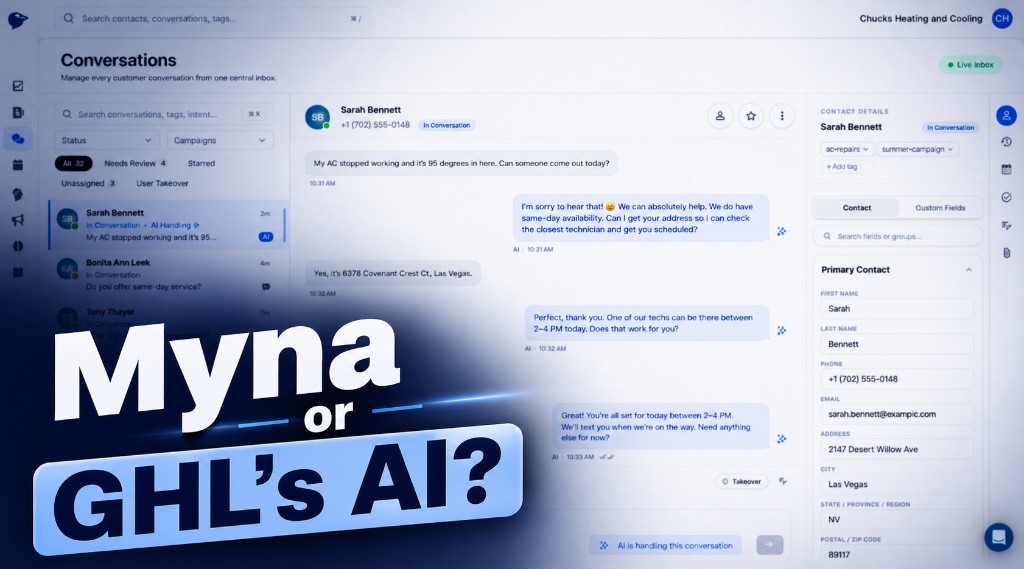
HighLevel’s documentation describes it as a tool for automating and scaling conversations across supported channels, including SMS, email, Facebook, Instagram, chat widget, and live chat depending on the account’s connected channels. It can answer common questions, suggest replies, collect information, support appointment booking, trigger workflows, hand off to a human, and keep conversations moving when the team is unavailable.
The important configuration choice is mode.
In Suggestive mode, Conversation AI drafts replies for a human to review, edit, and send manually. This is the safer way to launch because your team can see what the bot would say before a lead ever receives it.
In Autopilot mode, the AI sends replies automatically based on the bot’s settings, training, goals, and instructions.
Setup can be guided, prompt-based, or built through more workflow-style agent flows. The prompt-based setup gives agencies control over personality, goals, actions, and behavior. The workflow-style builder gives you a way to add steps, conditions, information capture, and branching logic so the bot can behave more specifically than a single broad prompt. The guided setup is faster for simpler use cases.
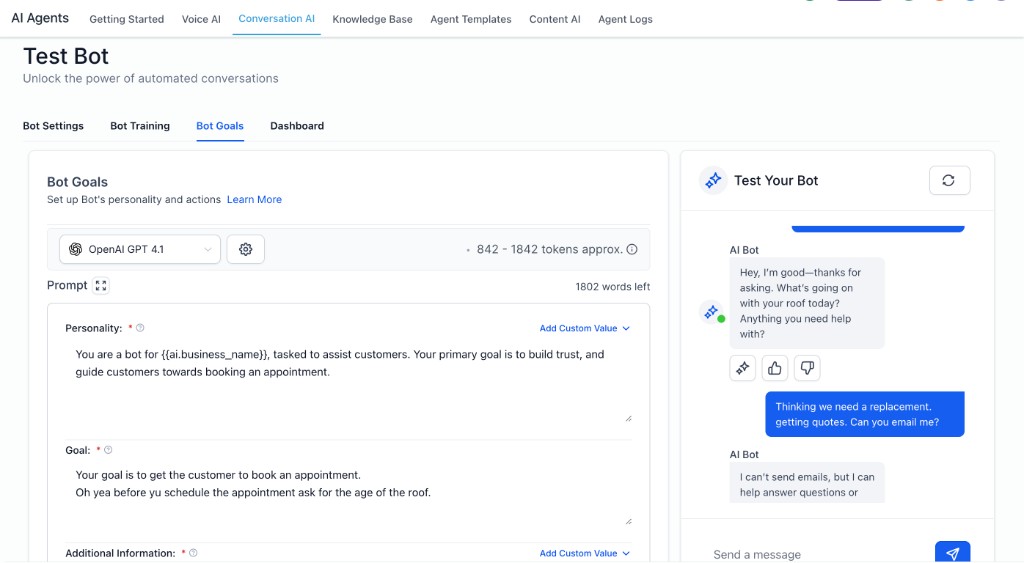
The prompt-based setup is flexible, but it also shows the first implementation burden: the bot’s behavior depends heavily on how well the agency writes and scopes these instructions.
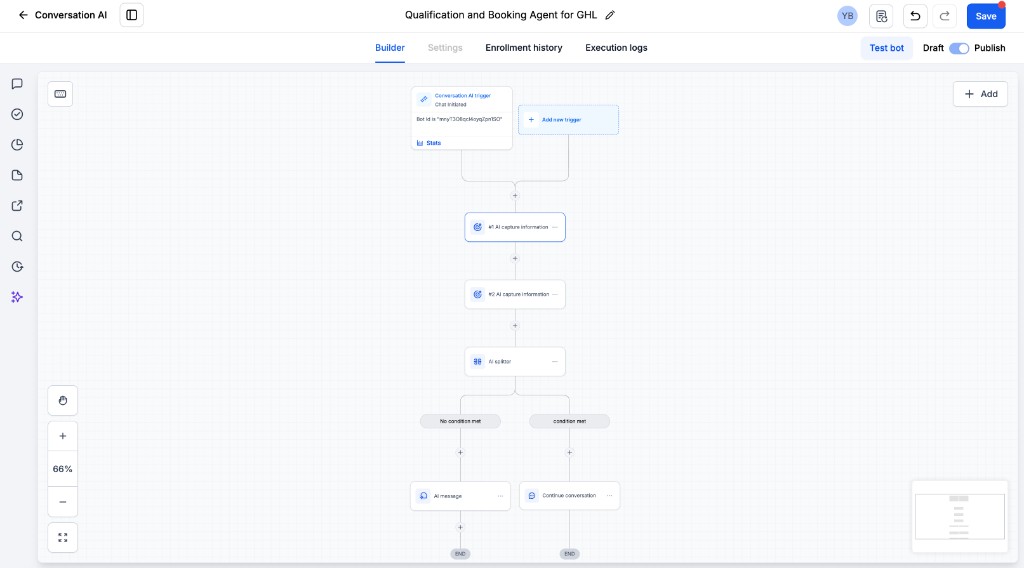
The workflow builder is the stronger option when you need more structure. It lets an agency model a qualification flow with information-capture steps, conditions, and follow-up actions. That is better than relying only on one prompt, but it still means the agency has to design, test, and maintain the logic. If the flow is incomplete, the bot still inherits the gaps.
Pricing has also evolved. HighLevel’s AI product pricing currently describes Conversation AI as token-based on pay-per-use, included with response limits on AI Employee Growth, and unlimited subject to fair use under AI Employee Unlimited. As always, verify current pricing directly in HighLevel before quoting a client.
That combination, native, multichannel, configurable, and tied to the existing CRM, is why agencies reach for it first.
What it does well
Start with the praise, because it is earned.
HighLevel is a serious platform with a large agency user base and strong public review presence across sites like Trustpilot, G2, and Capterra. People use it because it consolidates a lot of agency and client operations in one place: CRM, conversations, calendars, workflows, funnels, billing, and more.
Conversation AI fits that same pattern.
It is native. There is no separate integration to build. The bot lives inside the environment where your client already has contacts, calendars, workflows, and conversations. For agencies managing a lot of subaccounts, that matters.
It is multichannel. A lead might come through SMS, web chat, Facebook, Instagram, or another connected channel. Conversation AI gives agencies a way to cover those channels from the same HighLevel conversation layer instead of stitching together separate bots.
It is fast. Speed is most of the game in lead response. A bot that drafts or sends quickly gives clients a better chance to engage leads while they are still interested. That is the real ROI lever.
It is quick to launch. You can create a usable bot quickly, especially for clients with simple FAQs and straightforward appointment booking. For agencies onboarding at volume, speed of deployment matters.
It is cost-effective for the right client. Usage-based or bundled AI pricing can make sense for higher-volume, lower-ticket clients where the goal is fast response, basic qualification, and booking.
For many agency clients, that is the whole job done, and Conversation AI can do it well.
Where agencies have to put in the work
None of what follows is a knock on HighLevel specifically.
These are the realities of any broad native bot that has to serve many different business types through prompts, settings, and knowledge.
The default setup is not the finished product. If you give the bot thin instructions, you should expect thin answers. The agencies that get the best results are the ones that invest in the setup: business context, offers, service area, booking rules, escalation rules, tone, and boundaries.
Scope matters. A bot can only be trusted to auto-send when it knows what it should not answer. For low-risk FAQs, Autopilot can be fine. For pricing, claims, legal-sensitive language, medical or financial promises, or high-ticket qualification, you need stronger guardrails and a human fallback.
Robotic replies can hurt conversion. Leads can feel when a conversation is rigid. If the bot repeats itself, ignores context, or sounds like a generic script, people disengage. The fix is not just a better greeting. It is better business context, better examples, and tighter goals.
Qualification depends on configuration. If you need the bot to ask specific questions in a specific order, do not assume a generic prompt will hold that structure under pressure. HighLevel’s workflow-style builder can make this more structured with capture steps and conditions, but the quality still depends on how well the agency designs the flow. Test it with messy real-world conversations before trusting it on a high-value client.
Automation stacks can collide. Conversation AI may be running alongside workflows, assignment rules, notifications, pipelines, and third-party integrations. Test inside the client’s actual subaccount, not a clean demo account, because the real account is where edge cases appear.
High-ticket clients change the math. A wrong answer on a $200 booking is annoying. A wrong answer on a $20,000 roofing job, solar deal, legal consult, or high-value home service opportunity is expensive. For those accounts, instant AI response is still valuable, but you usually want more control over qualification, knowledge grounding, escalation, and reporting.
When HighLevel Conversation AI is the right call
Use it where it fits, because it fits a lot.
HighLevel Conversation AI is a strong choice when the client is already on GoHighLevel, has decent lead volume, asks mostly straightforward questions, and needs faster response across supported channels.
Think local service businesses with simple booking flows, straightforward FAQs, and lower-risk conversations. Configure the prompt properly, start in Suggestive mode, test hard, add escalation rules, then move to Autopilot only when you trust the output.
For a big share of agency clients, that is the right recommendation.
When to add a deeper layer on top
For clients where the stakes or complexity are higher, the smart move is not to rip out GoHighLevel.
It is to add a more specialized conversational layer on top for those accounts.
This is where Myna fits.
Myna can run alongside GoHighLevel, using the same CRM and calendar foundation, while adding a deeper SMS conversation layer for clients that need more control: high-ticket accounts, complex qualification, strict use-case scoping, long follow-up cycles, or agencies that want a fully white-labeled product they can sell as their own.
The difference is focus.
HighLevel Conversation AI is a native, general-purpose AI layer inside a broad platform. It can be prompt-based for simpler setups or workflow-based when you need more explicit qualification paths. Myna is built specifically around lead response, SMS qualification, follow-up, appointment booking, agency workspaces, white-labeling, rebilling support, and real tracking across clients.
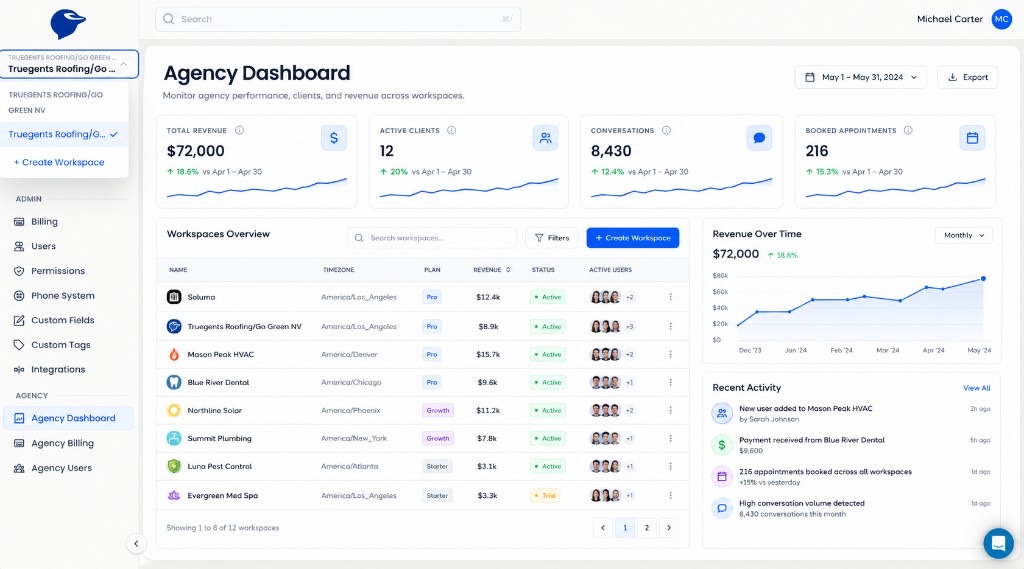
For an HVAC company, that means qualifying no-cool emergencies differently from tune-ups. For a roofer, it means ownership, damage, insurance path, roof age, inspection booking, and long claim-cycle follow-up. For an agency, it means multi-tenant workspaces, custom branding, a white-label domain, logo control, conversation analytics, booked appointment reporting, users, permissions, phone setup, tags, custom fields, and integrations from one dashboard.
That is not a replacement for GoHighLevel. It is a deeper layer for the clients where the native bot is not enough.
The practical setup a lot of agencies land on is simple:
Use HighLevel Conversation AI for simpler, lower-ticket clients where native coverage is perfect. Use Myna for the high-ticket or complex clients where deeper scoping, customization, white-label packaging, and appointment-focused tracking pay for themselves.
The two are not enemies. GoHighLevel is the foundation. Myna is the specialized conversation layer for the accounts that need it.
For the cost side of that decision, here is what an AI appointment setter actually costs. For the agency packaging side, read white-label SMS automation for GoHighLevel agencies.
The bottom line
HighLevel Conversation AI is a strong native tool that earns its place in many agency stacks.
It is fast, multichannel, built into the CRM, and genuinely useful for higher-volume clients with straightforward needs, as long as you configure it carefully, scope it tightly, and give it a human fallback.
Its limits are not unique failings. They are the normal limits of a broad native AI feature. For many clients, those limits are manageable. For high-ticket or complex clients, add a deeper layer on top rather than replacing the CRM.
That is the balanced answer.
Use HighLevel’s native Conversation AI where it is the right fit. Use Myna where the conversation itself is too valuable to leave to a generic setup.
Related reading
- Best Conversational AI for Small Businesses in 2026
- Do You Need GoHighLevel to Use an AI Appointment Setter?
- White-Label SMS Automation for GoHighLevel Agencies
- AI Appointment Setter vs. Human Appointment Setter
- How Much Does an AI Appointment Setter Cost?