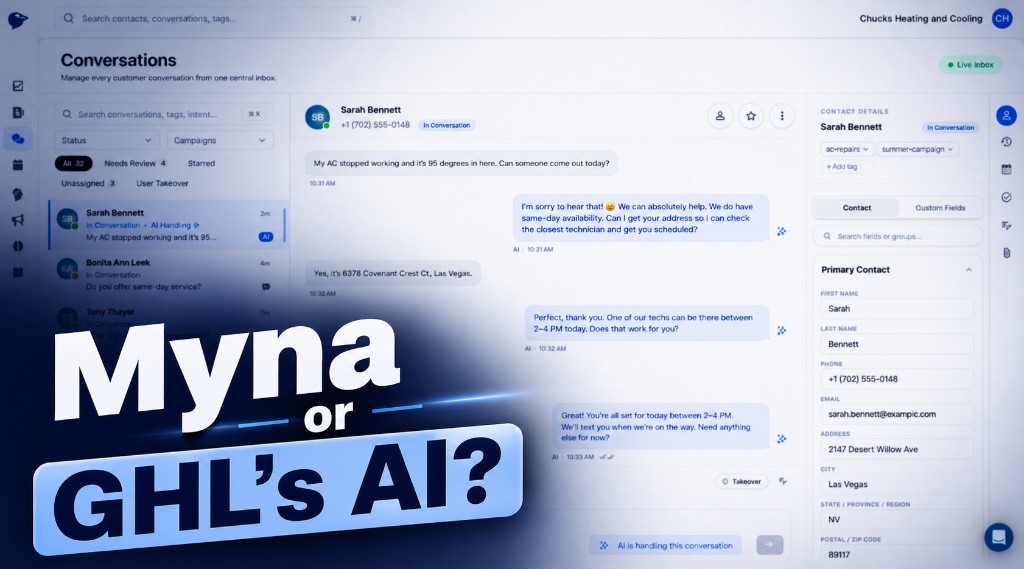
TL;DR: Model Context Protocol (MCP) is the new standard for connecting AI agents to the real world — CRMs, calendars, Meta ad platforms, lead sources, inventory systems, Slack, review platforms, and anything else your business runs on. Most AI tools are still built on brittle, one-off integrations that break when anything changes. Myna is built on MCP, which means your AI agent doesn’t just send texts — it understands where your leads came from, what they were interested in, what their history is, and can act across every tool in your stack through a single standardized layer. This is what separates an AI that chats from an AI that works.
The Integration Problem Nobody Is Talking About
Every AI agent demo looks impressive. The agent responds quickly, sounds human, handles objections, books the appointment. What the demo doesn’t show you is what happens six months later when you’re running it at scale across real business tools — a CRM that changes its API, a calendar integration that breaks after an update, a lead platform that doesn’t talk to anything else.
Most AI appointment setters and conversational AI tools are stitched together with custom integrations. One connector for Google Calendar. Another for HubSpot. Another for Twilio. Each one built specifically for that pairing, each one a potential point of failure, each one requiring engineering time when something breaks or when you want to add a new tool.
This is the integration problem. And it’s not getting smaller as businesses adopt more software — it’s getting exponentially worse. As BCG noted in their analysis of enterprise AI deployment: without a standardized protocol, the number of integrations required rises quadratically as AI agents and tools multiply across an organization. Every new agent and every new tool creates a new integration requirement. The math compounds fast.
MCP solves this. And it’s why Myna is built on it.
What MCP Actually Is
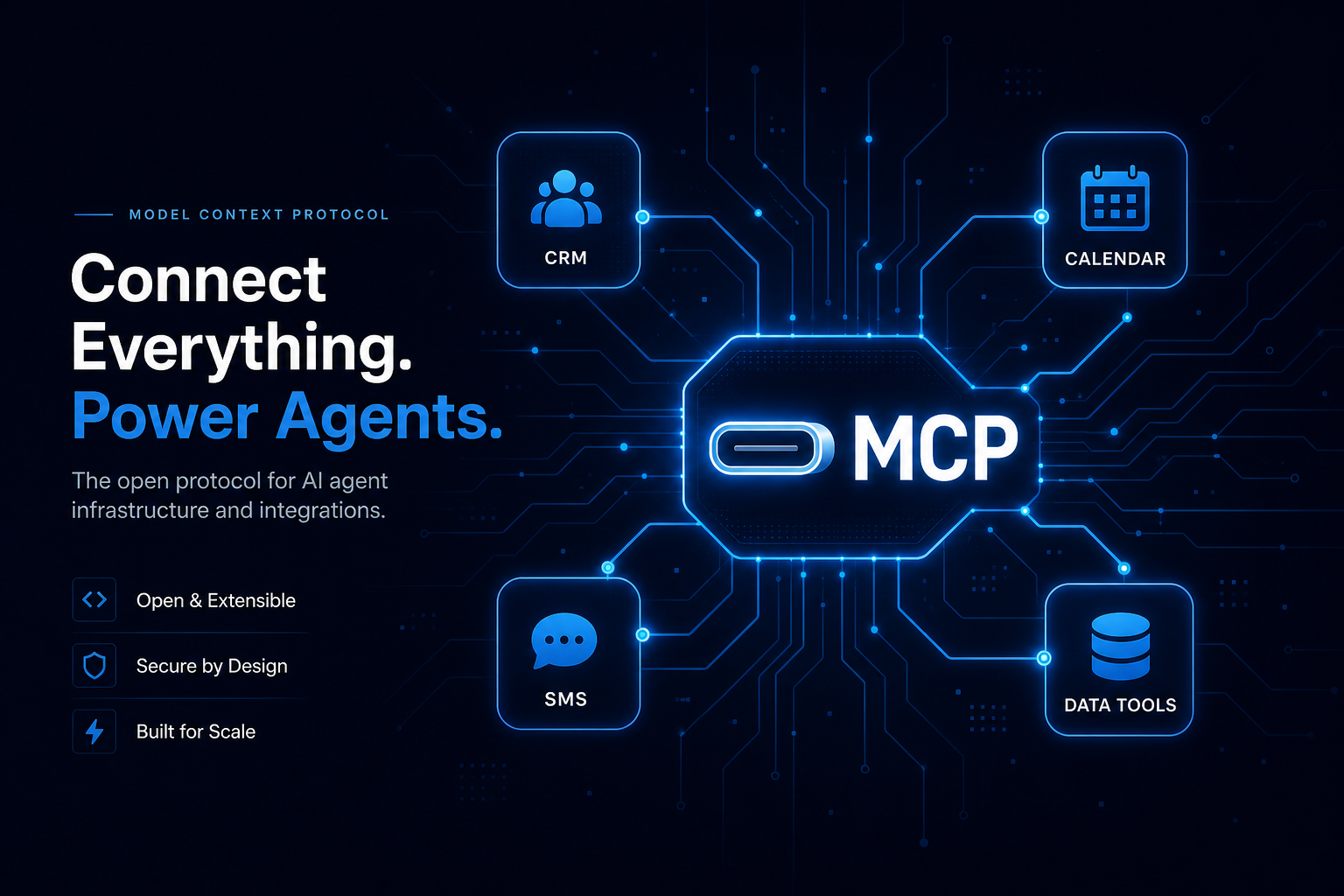
Model Context Protocol is an open standard introduced by Anthropic in late 2024. The simplest way to understand it: MCP is the USB-C port for AI agents.
Before USB-C, every device had its own cable, its own connector, its own standard. Plugging anything into anything required checking compatibility first. USB-C changed that — one connector works everywhere, with everything, by design.
MCP does the same thing for AI and business software. Instead of building a custom integration every time an AI agent needs to talk to a new tool or data source, MCP provides a universal interface. Any AI that speaks MCP can connect to any tool that has an MCP server. One protocol. Every system.
The AI community has moved fast on this. Since its introduction, tens of thousands of MCP servers have been built — GitHub, Slack, Salesforce, Google Calendar, HubSpot, and hundreds of others. ChatGPT, Claude, and most major AI platforms can act as MCP clients. What started as an Anthropic open-source project has become the de facto standard for AI-tool connectivity across the entire industry.
For businesses, this matters because it means the integrations your AI agent needs aren’t custom-built anymore. They exist. They’re maintained. And adding a new one doesn’t require an engineering sprint.
What MCP Makes Possible That Wasn’t Possible Before
The difference between an AI agent built on custom integrations and one built on MCP isn’t just technical cleanliness. It changes what the agent can actually do.
Real context, not assumed context
A traditional AI appointment setter knows what you put in its prompt. It knows the scripts you wrote, the FAQs you uploaded, the business hours you configured. That’s it. If a lead asks something the prompt didn’t anticipate, or if the context requires information that lives in your CRM, the agent is working blind.
An MCP-enabled agent can pull live data at the moment it’s needed. What’s this customer’s history? What jobs have they had done before? What’s their current status in the pipeline? The agent doesn’t guess — it checks. It retrieves the actual answer from the actual system in real time, and it uses that context to give a response that’s relevant to that specific person, not a generic script.
Action across systems, not just responses
Most conversational AI tools do one thing: generate a response. They’re reactive. The conversation happens, something gets said, the human has to take action on the other side.
MCP-enabled agents can act. They can update a CRM record after a qualification conversation. They can block a calendar slot as soon as a lead confirms an appointment. They can create a follow-up task, log a call outcome, trigger a pipeline stage change — all within the same conversation, without any human touching anything. The agent isn’t just talking about what should happen next. It’s doing it.
Multi-step workflows without hard-coded logic
Traditional agent workflows are brittle. If step 2 fails, the whole sequence breaks. If the business process changes, someone has to rewrite the automation logic. It’s the same problem as the integration problem — everything is custom, everything is connected to everything else, and changes cascade unpredictably.
MCP-enabled agents can dynamically sequence tool calls based on what they discover along the way. Retrieve a lead’s history, determine their qualification status, check calendar availability, book the appointment, update the CRM, send a confirmation — all in one flow, all adaptive to what each step returns. No hard-coded if-then chains. No brittle sequences. The agent reasons about what to do next based on real data, then does it.
The Scope Is Bigger Than Most People Realize
When people hear “MCP connects your AI to business tools,” they picture a CRM and a calendar. That’s a useful starting point, but it undersells what the protocol actually unlocks by a wide margin.
MCP is not a specific set of integrations. It’s a universal interface. Anything that exposes an MCP server becomes a tool your AI agent can read from, write to, and act on. The practical scope of that is enormous.
Advertising platforms. Myna’s AI can connect to Meta via MCP and understand exactly where a lead came from — which ad campaign, which ad set, which creative, which audience segment. A lead who clicked a Facebook ad targeting homeowners in Phoenix interested in solar has different context than a lead who came through a Google search for emergency HVAC repair. The agent knows the difference and can adjust its approach accordingly — different qualification questions, different urgency framing, different follow-up timing.
Lead source intelligence. The agent doesn’t just know a lead came in. It knows why they came in. Which platform, which campaign, what they were looking at before they filled out the form. That context shapes the entire conversation. A lead from a retargeting campaign for people who visited your pricing page is much closer to ready than a cold lead from a broad awareness campaign. With MCP, the agent treats them differently — automatically.
Ad performance feedback loops. Because MCP enables two-way data flow, Myna can write back to your advertising platforms. Qualified leads get logged. Booked appointments get attributed. The agent’s qualification outcomes become conversion signals that feed directly into your Meta or Google campaign optimization — without a human manually updating spreadsheets or firing pixels. Your ad campaigns get smarter in real time based on what the AI is actually booking.
Inventory and service availability. A plumbing company running MCP-connected AI can have the agent check actual technician schedules and service area coverage before confirming appointment availability — not just a static calendar, but live operational data. If you’re booked out two weeks in a specific zip code, the agent knows that and manages the lead’s expectations accurately instead of over-promising.
Customer purchase history and loyalty data. For businesses with repeat customers, MCP access to transaction history changes the entire quality of the conversation. The agent knows this customer had their HVAC serviced 14 months ago, that their unit is likely approaching the next maintenance window, and can reference that naturally. It’s the difference between a generic outreach text and a contextually intelligent one.
Review and reputation platforms. Agents can check a customer’s review history, understand sentiment from prior interactions, and adapt tone accordingly. If someone left a 5-star review six months ago, the agent can acknowledge the existing relationship. If there was a service issue, it can flag the conversation for human review before engaging.
Slack, email, project management tools. When a high-value lead comes in after hours, the MCP-connected agent can simultaneously engage the lead over SMS and fire a Slack notification to the owner with full lead context — without any Zapier workflows or manual automation setup. The agent is the orchestrator across all of it.
The pattern here is consistent: MCP turns your AI from a single-channel responder into a system that understands your entire business operation and can act across every tool you use. The ceiling on what it can connect to isn’t set by Myna’s integration roadmap. It’s set by what has an MCP server — and that list grows every week.
Why Myna Built on MCP
When we were designing Myna’s architecture, the question wasn’t whether to support integrations. Every AI platform supports integrations. The question was how to build them in a way that wouldn’t become a maintenance burden, wouldn’t break at scale, and wouldn’t limit what the agent could actually do.
The answer was MCP.
Myna’s AI agents operate through MCP, which means they’re not locked into the five integrations we decided to build first. They can connect to any tool that has an MCP server — and that ecosystem grows every week without us writing a line of integration code. When a new CRM becomes popular in the home services space, or when a contractor switches from one scheduling tool to another, the agent doesn’t need to be rebuilt. It just connects.
More importantly, Myna’s agents can do things that conversational AI built on custom integrations simply can’t do:
They can check a customer’s job history in your CRM before responding to an inbound lead. They can verify calendar availability in real time before proposing appointment times. They can update pipeline stages, create follow-up tasks, and log conversation outcomes — automatically, as part of the conversation flow. They can pull information from your knowledge base when a lead asks a question that requires a specific answer, not a generic one.
The agent isn’t operating in isolation, working from a prompt and hoping the context is sufficient. It’s operating inside your business, with access to the actual information and tools your team uses every day.
The Audit Trail That Enterprise Requires
One of MCP’s underappreciated advantages is interpretability. Every tool call made through MCP is a discrete, logged event. The agent called this tool, with these parameters, and got this result. That’s not just good engineering hygiene — it’s the foundation of accountability.
For businesses using AI at scale, this matters. When a lead claims they were never contacted, you can check the log. When a booking shows up on the calendar with no qualifying conversation behind it, you can trace the sequence. When a CRM record gets updated and nobody knows why, the audit trail is there.
Most AI appointment setters are black boxes. A conversation happens, something gets booked or doesn’t, and the reasoning is invisible. MCP-based agents produce a record of every action they take with external systems. That transparency is not a feature — it’s a requirement for anyone taking AI seriously in a real business context.
What This Means for Service Businesses Right Now
For contractors, HVAC companies, roofing businesses, solar installers — the practical implication of Myna’s MCP foundation is straightforward.
Your AI agent knows your business. Not because you spent three days uploading every document and configuring every scenario, but because it has access to the actual tools your business runs on. It can check your job history, your CRM, your calendar, your lead pipeline — and it can act on all of them, automatically, as part of every conversation.
A lead comes in at 9pm on a Sunday. The agent responds within seconds. It pulls the lead’s previous inquiry from the CRM — they asked about a roof inspection six months ago but never booked. It uses that context. It qualifies them, books the appointment, updates the CRM, creates a follow-up task for Monday morning, and sends a confirmation. Your team wakes up Monday to a booked appointment with full context already logged.
That’s not a demo scenario. That’s what MCP-enabled AI actually does when it’s built correctly.
The Standard Is Set. The Question Is Who Builds on It.
MCP has achieved something rare in the technology world: rapid, broad adoption from competitors who recognized the value of a shared standard over proprietary fragmentation. OpenAI, Google, Amazon, and Anthropic — companies that compete on almost everything — have all aligned around MCP because the alternative is a fragmented mess that’s bad for everyone.
That consensus means MCP isn’t a bet on an emerging technology. It’s a bet on the infrastructure that’s already won. The ecosystem of MCP servers will only get larger. The tools that support it will only get more capable. And AI platforms built on MCP will get access to all of that automatically, while platforms built on custom integrations keep falling further behind on maintenance.
Myna is built on MCP because that’s where serious AI infrastructure is going. Not because it was the easiest path — custom integrations are faster to ship initially — but because it’s the right foundation for a platform that’s supposed to get better over time, not more fragile.
The era of AI agents that just chat is ending. The era of AI agents that actually work inside your business — with your tools, your data, and your workflows — is what MCP makes possible.
That’s what Myna is building.
See what Myna can do for your business →
Sources
- Anthropic — Model Context Protocol Introduction. anthropic.com/news/model-context-protocol
- BCG — "Put AI Agents to Work Faster Using MCP." bcg.com/publications/2025/put-ai-to-work-faster-using-model-context-protocol
- ByteBridge — "Why MCP Still Matters in the Era of Advanced AI Agents." bytebridge.medium.com
- MCP Official Documentation. modelcontextprotocol.io
- Federal Communications Commission — TCPA Compliance Guidelines. fcc.gov/consumers/guides/stopping-unwanted-calls-and-texts
Related: