
TL;DR: Message debouncing lets an SMS AI agent wait for a pause, collect a burst of texts, and answer the whole thought once. A safe design also deduplicates webhooks, coordinates workers, and preserves messages that arrive while a reply is being prepared.
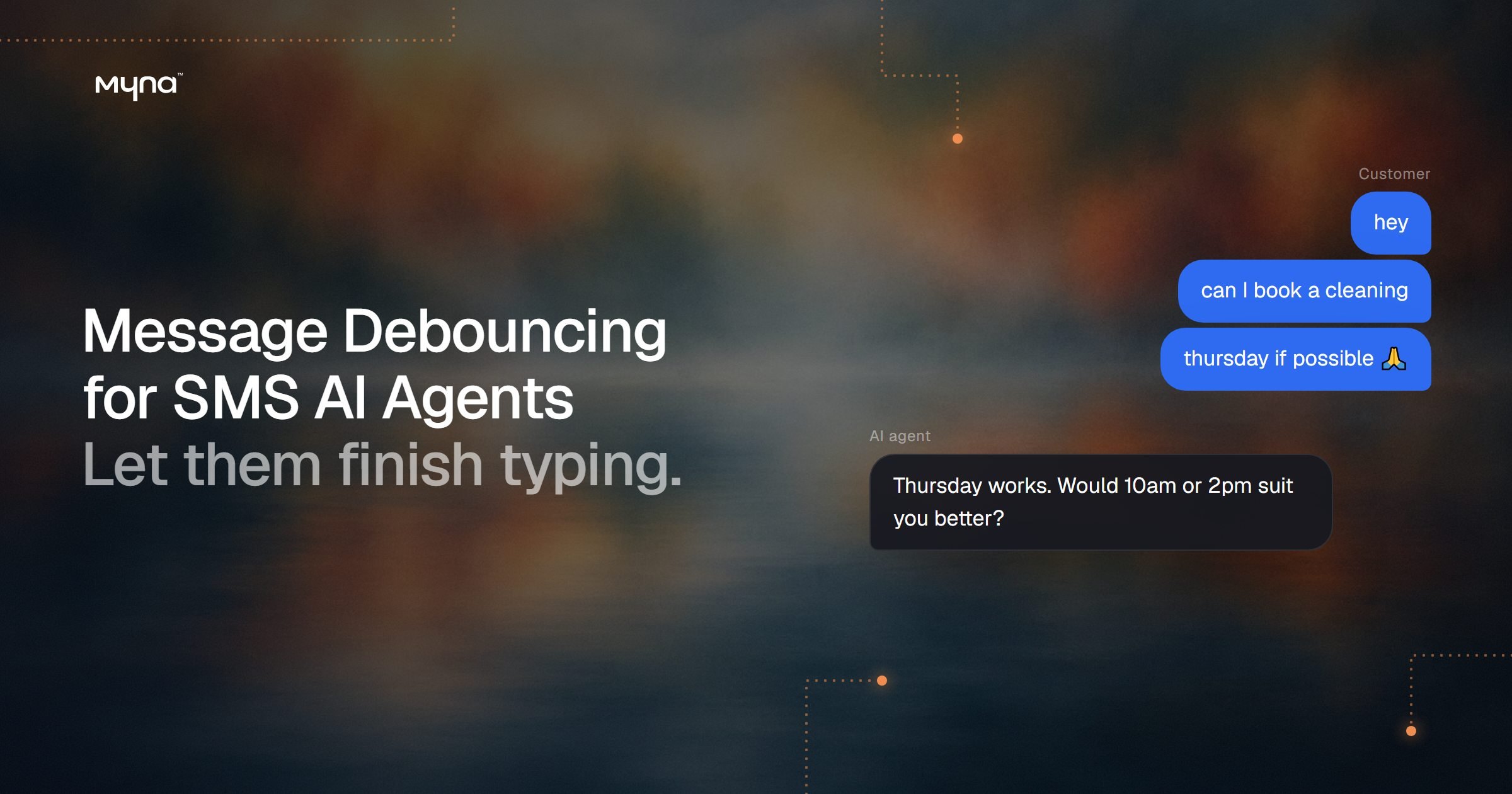
A customer texts an HVAC company: “Is anyone available tomorrow?” Then another message arrives: “The upstairs unit stopped cooling.” A third adds: “Afternoon works best.”
If your agent starts a model call for each fragment, it can send three replies to one request. Those replies may contradict each other, miss information that arrived moments later, or waste model calls. The harder problem is not waiting for a pause. It is deciding exactly which messages a worker owns when webhooks, delayed tasks, and new texts overlap.
What is message debouncing for an SMS AI agent?
Message debouncing groups incoming texts from one conversation into a turn after a period without a newer message. Each new arrival moves the effective end of the waiting period, so the agent sees more of the customer’s thought before responding.
The pattern differs from simply sleeping after every webhook. Each message is buffered, and each arrival schedules a delayed check. When a check runs, it asks whether a newer message has arrived and whether the most recent message has already waited long enough.
| Concern | Reply instantly | Debounce |
|---|---|---|
| Split thoughts | Each fragment can trigger a reply | A pause groups fragments into one turn |
| Model calls | Multiple calls may cover one request | One call can cover the burst |
| Response latency | No intentional wait | Includes a configured wait |
| New messages during generation | Need separate handling | Still need separate handling |
Debouncing is part of the system around the model, not a prompt telling it to be patient. The broader AI agent harness decides when the model runs and what information it can use.
How does a Redis message buffer and Celery countdown work?
A practical debounce pattern appends each inbound event to a conversation buffer, schedules a delayed task, and lets the task inspect the newest arrival before claiming a turn.
A Redis-backed buffer can hold each message, its provider event ID, and its arrival timestamp. The webhook handler also records the inbound message in the message log and conversation memory immediately. That write must not depend on the debounce timer firing, because the conversation record should survive a delayed or failed reply task.
The handler schedules a Celery task using a countdown equal to the campaign’s response delay. Celery supports scheduling a task with a countdown, although scheduling is not a substitute for monitoring worker and broker health.[1] Each campaign can have its own delay, rather than forcing the same pace on an urgent intake and a longer support exchange.
When a task runs, it compares the newest buffered message’s timestamp with the time that task was queued. If a newer message arrived, the older task normally skips: the newer arrival has scheduled another task that can answer the accumulated burst.
There is a safety valve. If the configured response delay has already passed since the newest message, an older task can process the burst anyway. That gives the buffer another chance to progress when a newer task is delayed or unavailable. It does not remove the need for retries and monitoring if the queue or workers are down.
Use a consistent clock for queue and arrival times. If timestamps can tie, add an ordering value so a newer event is not mistaken for an older one. The buffer append and scheduling path also need a recovery strategy if the process fails between those operations.
What does a simplified debounce worker look like?
The following sketch shows the decision, not a complete production implementation. The helper functions stand in for storage, scheduling, claims, and reply delivery. In particular, the claim must be atomic across workers, and the scheduling helper must reliably enqueue the Celery task.
Pythonfrom celery import shared_task


def on_message(event, campaign):
    if not accept_and_record(event):
        return  # Duplicate event
    queued_at = append_to_redis_buffer(event)
    enqueue(run_turn, event.conversation, queued_at,
            countdown=campaign.response_delay)


@shared_task
def run_turn(conversation, queued_at):
    if not workspace_is_active(conversation):
        return

    newest = newest_buffered_message(conversation)
    if newest is None:
        return

    delay = response_delay(conversation)
    if newest.arrived_at > queued_at and age(newest) < delay:
        return  # A newer task should handle the burst

    turn = claim_buffered_snapshot(conversation)
    if turn is None:
        retry_when_claim_available(conversation, queued_at)
        return

    if not workspace_is_active(conversation):
        release_claim(turn)
        return

    reply_and_record_result(turn)
    remove_answered_messages(turn)
    release_claim(turn)
Here, accept_and_record represents immediate, durable inbound recording with duplicate protection. append_to_redis_buffer returns the timestamp associated with the buffered arrival. The sketch omits error handling, claim expiration, recovery, and the details of delivery, all of which need explicit designs before deployment.
The workspace check matters because a business can pause while a task waits in the queue. Check again before a reply is sent, and define what happens to retained messages when the workspace resumes. A check at task start alone cannot prevent every pause race.
How do you prevent duplicate replies from webhook retries?
Treat provider event deduplication and reply deduplication as separate safeguards. A repeated webhook should not be appended twice, and competing or retried workers should not independently send the same burst’s reply.
One approach uses a Redis SET with NX and an expiration of 24 hours for each provider event ID. NX makes the write conditional on the identifier not already existing; Redis also supports an expiration option on SET.[2] The 24 hour window is a design choice, not an unlimited guarantee. A duplicate arriving after that window needs a longer-lived record if it must also be recognized.
Be careful with the gap between claiming an event ID and saving its message. If the process stops after the claim but before the durable write, a retry could be discarded even though the message was never recorded. Coordinate those operations atomically where possible, or use a recoverable record and retry process.
For a burst, derive a stable turn ID from a hash of its provider event IDs in a canonical order. Store the ID with the claimed snapshot and reply result. A retried worker can then identify the same turn instead of treating it as new work.
The turn ID alone does not guarantee exactly one outbound SMS. A worker can fail after the provider accepts a message but before the application records success. Use a provider-supported idempotency mechanism when available, and otherwise design reconciliation for uncertain sends. Apply the same caution to side effects such as booking an appointment.
This is where pre-gates and post-gates fit around the model: deterministic checks can protect actions and verify results, while the model handles the conversational work.
What happens when another text arrives during a reply?
A worker should clear only the buffered messages included in the turn it actually answered. It must not empty the entire conversation buffer after generating a response.
Suppose the worker claims the first three texts and starts preparing a reply. The customer then adds, “Actually, morning is better.” That fourth message belongs to the next turn. Deleting the whole buffer would lose it; deleting only the claimed event IDs preserves it.
Serialize turns for a conversation, or otherwise coordinate them so two workers do not claim overlapping messages. If a worker finds an existing claim, it needs a retry or wake-up path rather than silently abandoning the newer message. If a worker dies, an expiring claim and a recovery process can make the snapshot available again.
The log and conversation memory should already contain the fourth message, but the first reply should remain grounded in the snapshot it actually processed. When the next turn runs, it can use that new message and the recorded conversation history. For longer threads, rolling conversation summaries explain one approach to keeping older context usable.
How should you choose and test the delay?
Choose a campaign delay by testing the balance between a coherent reply and a response that feels prompt. A longer wait can merge more fragments; a shorter wait reduces intentional latency but may split a customer’s thought across turns.
Start with a representative set of conversations rather than optimizing for the shortest possible timer. An appointment intake may need a different setting from a support exchange where customers tend to add details in separate texts. Review the actual replies as well as the timing.
Before enabling the pattern, test these cases:
- A normal burst: Send several fragments inside the delay and verify that one claimed turn contains them all.
- A delayed task: Run an older task after the latest message has waited through the delay and verify that the safety valve can claim the burst.
- A duplicate webhook: Deliver the same provider event again and verify that it does not create another buffered message or reply.
- A message during generation: Add a new event after the snapshot is claimed and verify that it remains for the next turn.
- A paused workspace: Pause while a task is queued and verify that the task does not send a reply while the workspace is inactive.
- A worker failure: Interrupt processing around the claim and send steps, then verify recovery without losing the inbound message.
Measure the time from the latest inbound message to the reply, the number of fragments per claimed turn, and duplicate or missing replies. Review queue delays and abandoned claims alongside those measures. A faster average is not a useful result if customers receive contradictory replies or their messages disappear.
For the surrounding architecture, read how an agent harness handles a customer message.