

TL;DR: Conversational AI works now, which is more than could be said for it ten years ago, but the shape it has taken is quite different from what the first wave of chatbots promised. Eight shifts look likely to define it in 2027: agents judged on outcomes, tools connected through shared standards, claims checked before they’re sent, voice catching up with text, memory that chooses what to keep, people supervising instead of rescuing, smaller models doing most of the talking, and disclosure written into law. None of them is about the model getting cleverer, and all of them are about the system around it getting more careful.
In the spring of 2016, the technology industry decided that chatbots were the future. Microsoft’s chief executive told developers at the company’s annual conference that bots were the new apps, Facebook opened Messenger to bots a few weeks later, and for a while it seemed that every airline, florist and pizza chain was racing to let customers order through a chat window. Within a year, reports suggested that the bots on Facebook’s platform were failing to complete around 70 percent of requests without a person stepping in, and most of them quietly disappeared, leaving behind a generation of customers who learned to type “agent” or “human” as their opening message.

Ten years later, conversational AI does mostly work. Agents book appointments, answer questions from real knowledge, open support tickets and hand conversations to the right person, often in the middle of the night and in more languages than the business itself speaks. But the version that works looks very little like the one predicted in 2016, because most of the progress came from building careful systems around the conversation, and that pattern looks set to continue.
What follows are eight shifts that seem likely to shape conversational AI over the next year. They come from what is already visible in production agents, in the way vendors are pricing their products, and in laws that are about to take effect, so most of them can already be seen somewhere today.
1. Outcomes become the scoreboard
For most of its history, conversational AI was measured by activity. Vendors reported how many conversations a bot had handled, how many messages it had sent and what share of customers it had kept away from the support team, a figure the industry called deflection, which in fairness is also what you call it when a goalkeeper gets a fingertip to the ball and it goes in anyway. None of these numbers told a business whether the customer actually got what they came for.
That is changing quickly, partly because the agents can now do more than talk. Once an agent can book an appointment, issue a refund or update an order, the obvious question is whether it did, and the more useful metrics have become the ones that count outcomes: appointments booked, issues resolved, conversations handed to a person with everything they need, and those that ended without any result at all. Pricing has started to follow. Intercom has charged for its Fin agent per resolution since 2023, and Gartner predicts that by 2029, agents will resolve 80 percent of common customer service issues without human help.
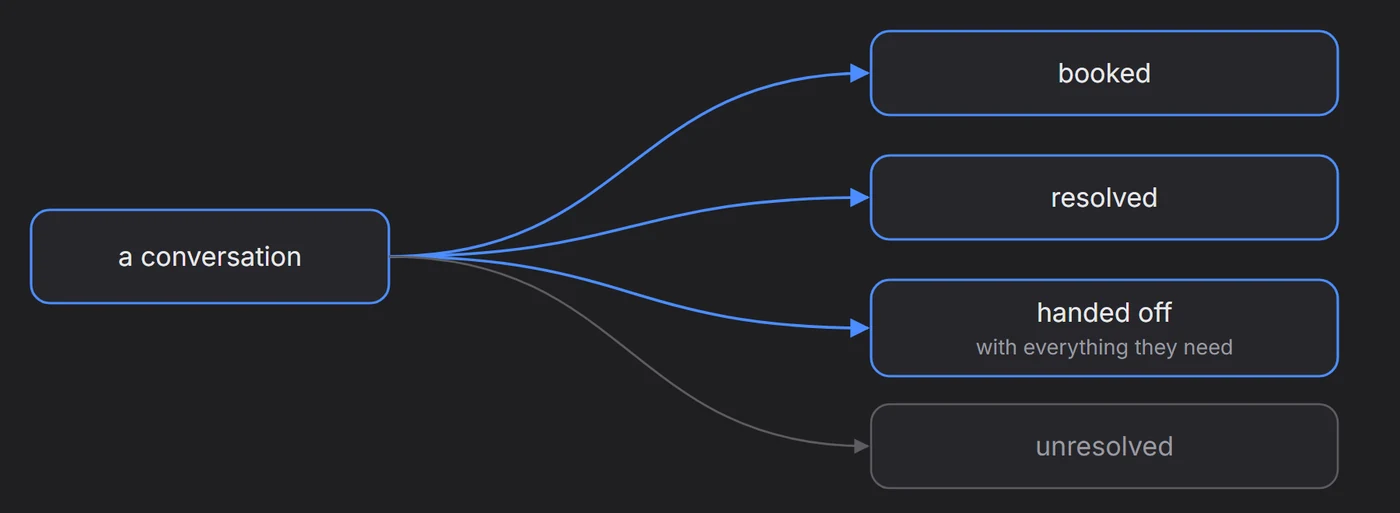
The practical effect is that a long, friendly conversation which ends without a booking now counts as a failure, which is a much healthier way to look at it. It also changes how agents are designed, since an agent judged on outcomes is rewarded for asking the right question early, for knowing when to hand over, and for getting out of the way once the job is done.
2. Tools arrive through a shared plug
An agent is only as useful as the systems it can reach, and until recently every connection between an agent and a calendar, a CRM or a payment system had to be built by hand, separately for each product. The Model Context Protocol, which Anthropic introduced in late 2024 and which OpenAI, Google and Microsoft have since adopted, gives agents and business systems a common way to describe what tools exist and how to call them, in much the same way that USB gave every printer and keyboard the same shaped plug.
What matters for 2027 is how ordinary the protocol makes these connections. A business that already uses a booking system, a help desk and a CRM can expect a new agent to connect to all three without a custom integration project, which means the agents that stand out will be the ones that use those connections carefully, with permissions, limits and a record of every action they take.
The question to ask about any integration: what is the agent allowed to do with it, and where can you see a record of what it did?
3. Every claim gets checked before it’s sent
The most damaging thing a conversational agent can do is say that something happened when it didn’t. A model that has been asked to book an appointment can write “You’re all booked for Tuesday at 10!” with complete confidence, whether or not the booking went through, because writing the sentence and making the booking are two separate acts and only one of them depends on the model.
The response across the industry has been to stop taking the model’s word for it. Before a reply is sent, the claims in it are compared with what the agent’s tools actually reported during the turn, and a reply that confirms a booking nobody made is either corrected or held back. The idea is borrowed from how careful people work, since a good receptionist doesn’t tell a patient they’re booked until the appointment is on the screen in front of them.
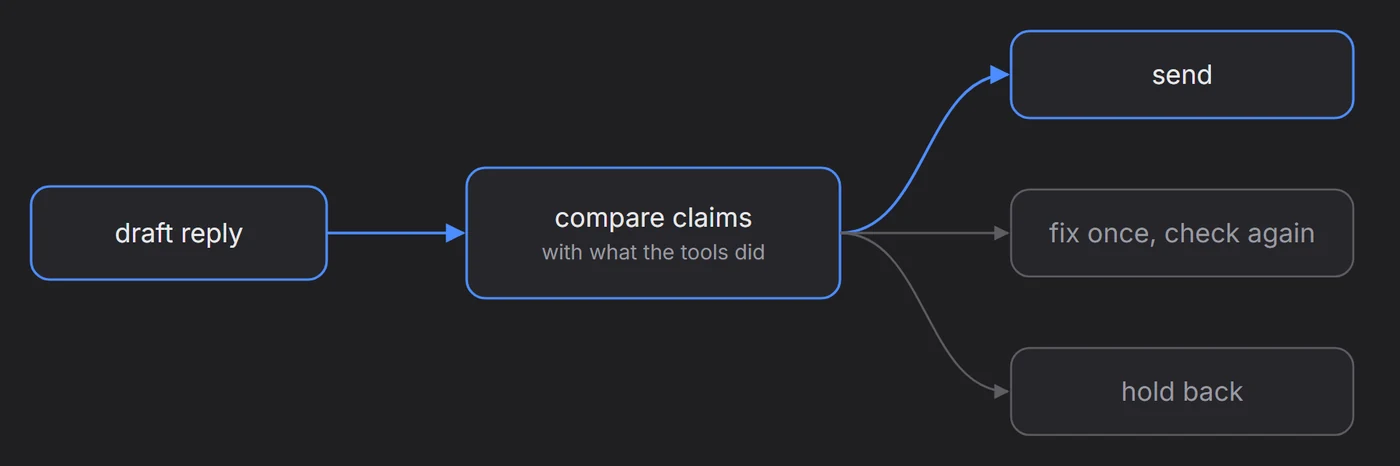
This kind of check is cheap, because it uses fixed rules instead of a second model, and it gives the same verdict every time. In 2027, an agent without one will look roughly the way a website without HTTPS looks today, technically functional and quietly alarming to anyone who knows what to look for.
4. Voice catches up with text
Most of the progress in conversational AI over the past few years has happened in text, partly because text is forgiving. A customer will wait three seconds for a reply in a chat window without noticing, but three seconds of silence on a phone call feels like the line has dropped, since in ordinary speech people take turns with gaps of around a fifth of a second. Voice agents built by chaining speech recognition, a language model and a text-to-speech system struggled to get anywhere near that, and the result was the halting, slightly robotic phone experience most people have learned to dread.
Speech-to-speech models, which listen and respond in audio directly, have narrowed that gap considerably, and handle interruptions, hesitations and changes of mind far better than the older pipelines did. For businesses that take most of their bookings by phone, which includes a large share of clinics, salons, contractors and restaurants, this is likely to be the shift that matters most in 2027. The hard problems will be the same ones text agents have already worked through, such as what the agent is allowed to promise and when it should hand the call to a person, only now with the added difficulty of doing all of it in under a second.
5. Memory learns to forget
Early conversational agents had two settings, which were remembering nothing between conversations or sending the model the entire history every time, and neither worked particularly well. The first made customers repeat themselves, while the second was expensive, slow and surprisingly unreliable, since models tend to pay less attention to information buried in the middle of a long transcript.
The approach that has taken over is more selective. Agents keep a short rolling summary of a long conversation instead of the full transcript, save specific facts such as a customer’s preferred day or the visit they’re booking as structured fields, and store corrections from the team so that a mistake made once isn’t made again. Just as importantly, they forget on purpose, dropping old details that no longer matter and avoiding storing anything a customer wouldn’t expect a business to keep.
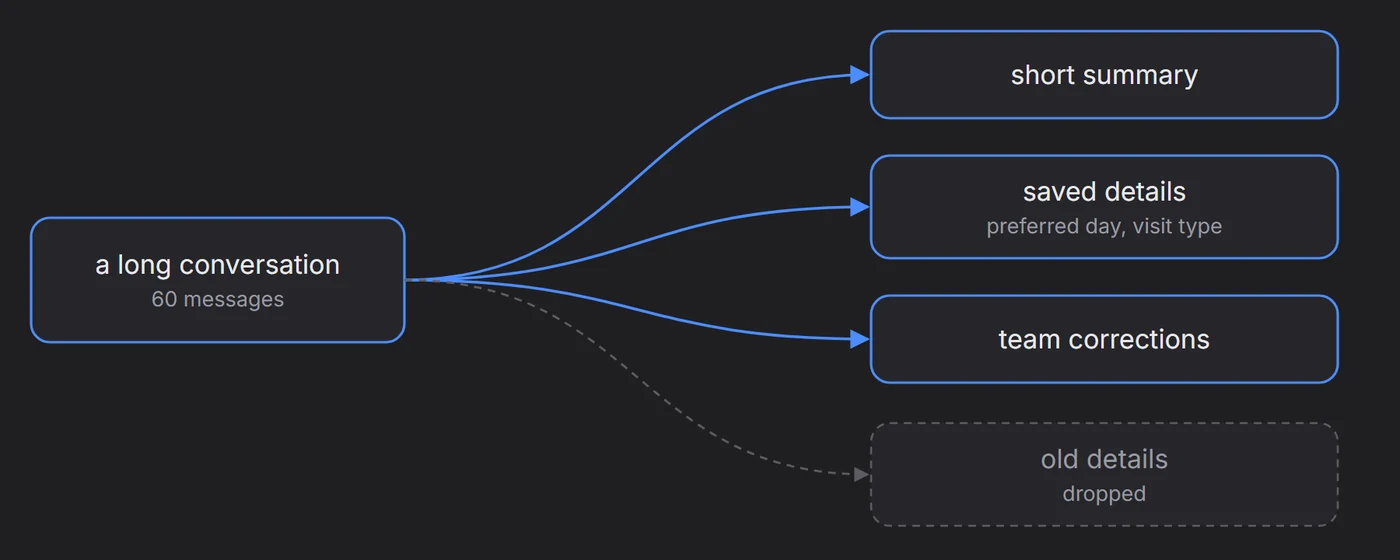
This matters for privacy as much as for quality. An agent that remembers everything is a liability under most data protection rules, while one that remembers what it needs and can explain why is much easier to trust.
6. People move from rescue to supervision
In the first generation of chatbots, people were the emergency exit. The bot handled what it could, and when it failed, which was often, the customer was passed to a person who had to read back through the conversation, apologise for the bot and start again, so most of the person’s job was cleaning up.
The arrangement that is emerging gives people a different job. Agents now prepare actions that need sign-off, such as a refund above a certain amount or an exception to a policy, and a person approves or adjusts them in a few seconds instead of handling the whole conversation. When a person does take over, the agent steps back completely and stays quiet until it’s handed back, so the customer never receives an automated follow-up in the middle of a manager’s personal apology. And the corrections people make are fed back into the agent’s memory, so supervision improves the agent over time.
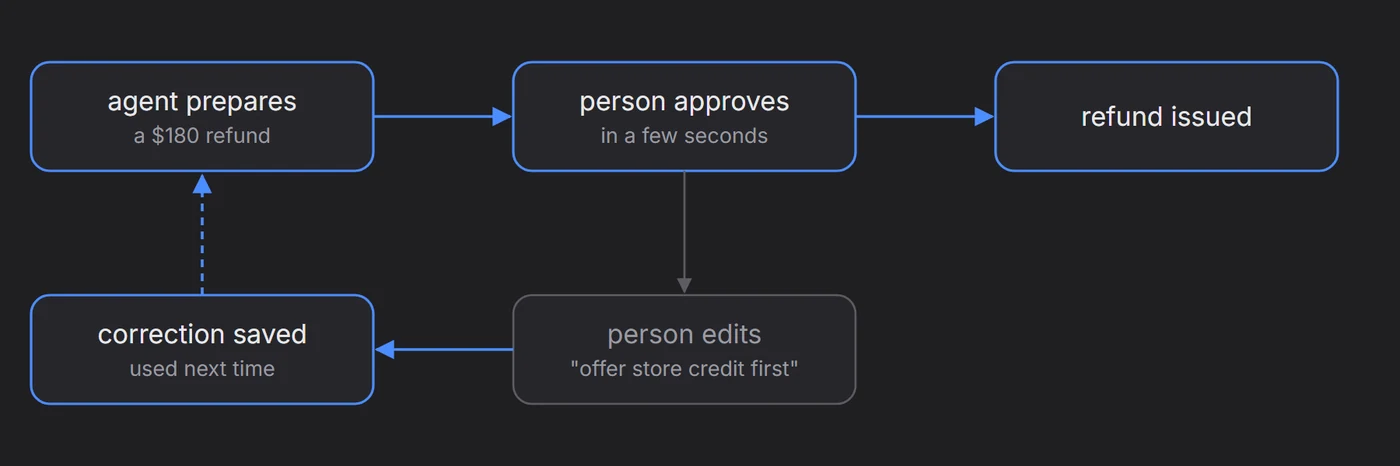
This is a better use of a team’s time, and probably a better job too. Reviewing a draft refund and pressing approve is considerably more pleasant than inheriting an angry customer who has spent ten minutes arguing with a bot.
7. Smaller models do most of the talking
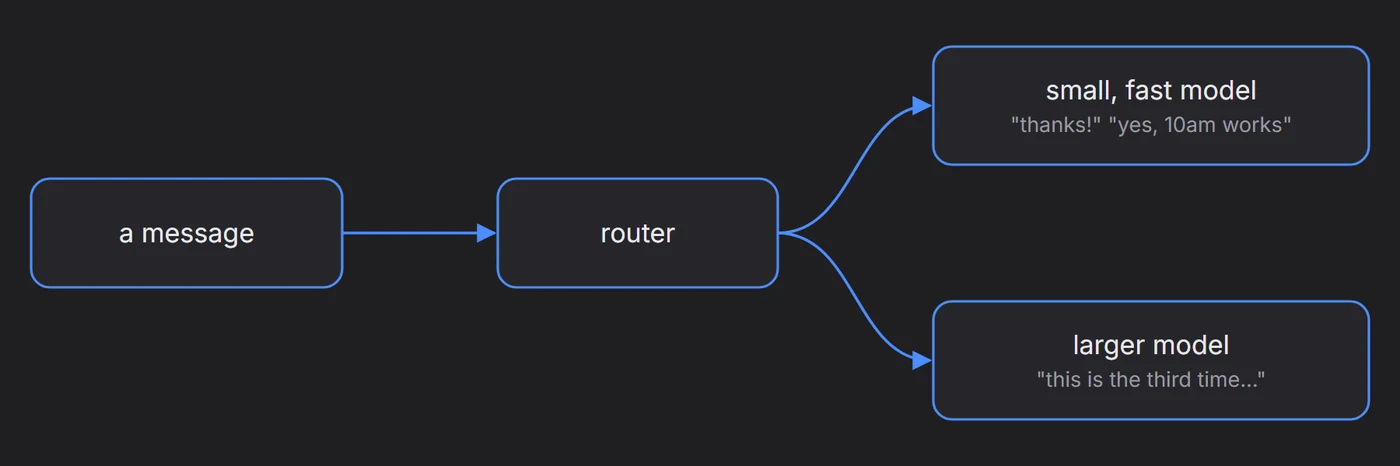
Not every message needs the most capable model available. A customer who writes “thanks!” or “yes, 10am works” doesn’t require deep reasoning, and sending that message to the largest, slowest and most expensive model is a little like calling in a surgeon to put on a plaster. The industry has started to route turns accordingly, with OpenAI building a router into GPT-5 that decides between a fast model and a slower reasoning one, and conversational platforms doing something similar at the level of each turn.
| Kind of turn | Usually handled by |
|---|---|
| Greetings, thanks and confirmations | A small, fast model, or no model at all |
| Questions answered from the knowledge base | A small or mid-sized model |
| Booking steps and required questions | A mid-sized model working through tools |
| Complaints, exceptions and multi-step requests | A larger reasoning model |
The result is faster replies for most of the conversation and lower costs overall, which matters a great deal for businesses where a single agent might handle thousands of conversations a month. The skill in 2027 will be knowing which turns are genuinely difficult, since a complaint disguised as a simple question is exactly the kind of message a small model will answer cheerfully and wrongly.
8. Disclosure becomes part of the product
For years, many businesses gave their chatbots human names and left customers to work out for themselves who they were talking to. That is becoming harder to do legally, and it was never particularly good for trust.
| Rule | What it requires | In force |
|---|---|---|
| California BOT Act | Bots used to sell to people in California, or to influence their vote, must disclose that they are bots | Since July 2019 |
| US carrier rules for business texting (A2P 10DLC) | Businesses sending texts from ordinary US numbers must register, and carriers block unregistered traffic | Enforced since early 2025 |
| EU AI Act, Article 50 | People must be told when they are interacting with an AI system, unless it is obvious | From August 2026 |
The shift for 2027 is that disclosure stops being a legal footnote and becomes part of how agents are designed. An agent can still have a name, a warm voice and a bit of personality, but it says it’s an AI whenever someone asks, its opt-out handling works the same way every time, and the business can show a regulator exactly what it said and why. Agents that do this well tend to be trusted more, which suggests the law is mostly catching up with what customers wanted anyway.
How Myna fits in: several of these shifts are built into how Myna agents work today. Replies are checked against what the agent’s tools reported before they’re sent, opt-outs and human takeovers are handled by fixed rules before the model runs, long conversations are kept in a rolling summary, and corrections from the team are stored and looked up again before similar replies.
What these shifts add up to
Taken together, these eight shifts point in a fairly consistent direction. Conversational AI is growing up in the way most technologies do, by becoming less impressive in demonstrations and more dependable in daily use, and almost none of the progress described here depends on the underlying model becoming more intelligent. It comes from deciding what the agent should be measured on, what it’s allowed to touch, what it must check, what it should remember, when a person should step in, which model each turn deserves, and what it owes the customer in honesty.
The chatbots of 2016 were built to show that a machine could hold a conversation, and they stumbled on the part that mattered to customers, which was getting to the end of one with something done. The agents that will matter in 2027 are being built around exactly that, and the businesses that take it seriously will spend the next year improving the systems around their agents, since that is where nearly all of the difference now lies.