
TL;DR: Language models are trained in a way that rewards saying more, which is why so many AI agents answer a yes-or-no question with three paragraphs and a closing offer of further help. The agents that work best in real customer conversations go the other way. They decide before the model runs whether a message needs a reply at all, they wait for the customer to finish typing, and when they do speak, they say only what the moment needs. This post looks at where the talking habit comes from, what it costs, and how to build an agent that knows when to stop.
When Philip II of Macedon was busy conquering most of Greece, the story goes that he sent a message to Sparta warning that if he brought his army into their land, he would destroy their farms, kill their people and raze their city. The Spartans read the message, considered it, and sent back a reply consisting of a single word: “If.” Philip left Sparta alone, and the region the Spartans came from, Laconia, gave English the word laconic.

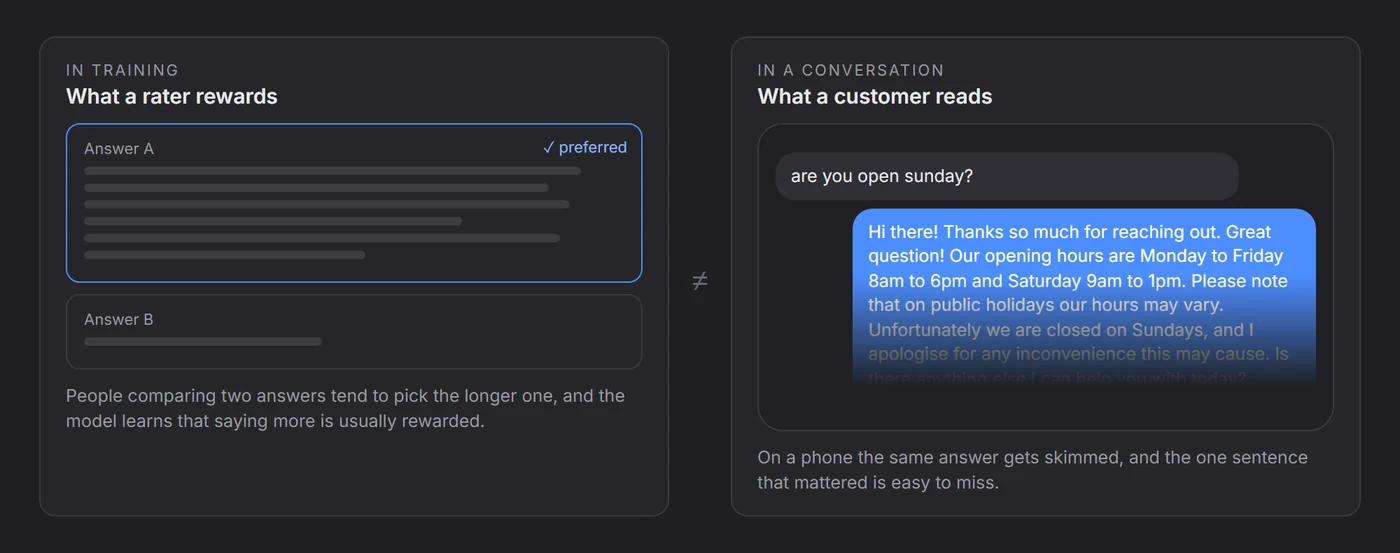
Very little about modern customer conversations is laconic. Ask a typical AI agent whether a shop is open on Sunday and you are likely to receive a warm greeting, a restatement of your question, the opening hours for the entire week, a note about public holidays, an apology for any inconvenience and a closing offer to help with anything else today, which is a lot of reading for someone who wanted to know whether to put their shoes on. The answer was in there somewhere, but the customer had to dig for it, and on a phone screen that digging feels a lot like being ignored.
The habit is so common that people have stopped noticing it as a design decision, but it is one, and the teams building the most effective conversational agents are now deliberately undoing it. Their agents reply less often, write shorter messages, and in a surprising number of situations don’t reply at all. This post looks at where the talking habit comes from, why it costs more than it seems to, and what an agent that knows when to stop actually looks like.
Why models like to talk
Large language models come by their chattiness honestly. After their initial training, most of them are tuned on human feedback, where people compare pairs of answers and pick the better one, and a reward model learns to predict those preferences so the language model can be trained to satisfy it. The trouble is that people rating answers tend to be impressed by thoroughness, and a longer answer usually looks more thorough even when it isn’t. When researchers at the University of Texas looked at this closely in 2023, they found that a large share of the improvement attributed to this kind of training could be reproduced simply by making answers longer, which suggests that the models had learned, quite reasonably from their point of view, that more is generally better.
Linguists had described the opposite rule decades earlier. In 1975, the philosopher Paul Grice set out a handful of principles that people follow, mostly without thinking, to keep a conversation cooperative, and the first of them, the maxim of quantity, asks each speaker to make their contribution as informative as required and no more informative than that. Human listeners notice when this rule is broken in either direction. A colleague who answers “how was the meeting?” with “fine” is being slightly unhelpful, and one who answers with a forty-minute summary is being something worse, because the length itself starts to carry a message, usually that the speaker wasn’t listening to what you actually asked.
Grice’s maxim of quantity: make your contribution as informative as the conversation requires, and no more informative than that.
A model trained to impress a rater is therefore pulling in roughly the opposite direction from the person it is talking to. The long answer does well in a demo, where someone is evaluating the agent and reading every word, and much less well in a real conversation, where a customer is glancing at a text between other things and quietly stops reading carefully, and the agent never finds out, because nobody replies to say that a message was too long.
What saying too much costs
The obvious cost is attention. A customer who has to read four sentences to find one answer is less likely to act on it, and if the answer they needed was in the third sentence, there is a reasonable chance they missed it altogether and will write back to ask again, which means the agent has just generated a second conversation turn to make up for the length of the first.
There is also a cost in money, and it arrives in two places. The first is the model itself, which is billed by the amount of text it reads and writes, so an agent that writes three paragraphs where one sentence would do is paying for the difference on every turn, in every conversation, forever. The second is less visible and particular to text messages. A standard SMS segment holds 160 characters, and longer messages are split into several segments that are each billed separately, but a single emoji switches the whole message to a different character set in which each segment holds only 70 characters. A friendly reply of 300 characters with a single emoji in it can therefore leave the building as five billable messages instead of two.
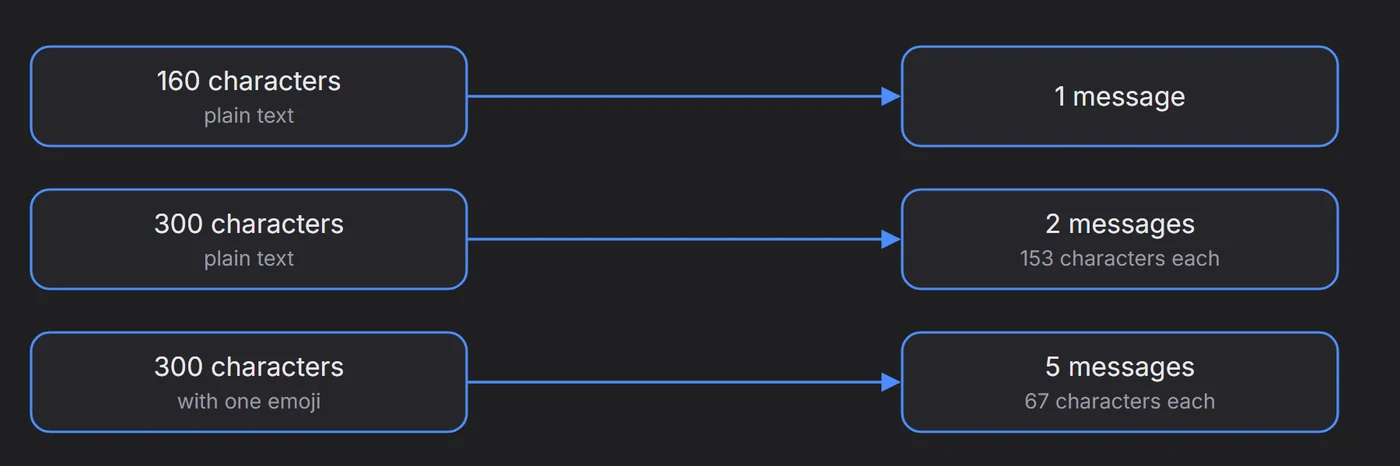
Worth checking on your own account: look at the last twenty texts your agent sent and count how many carried an emoji. On SMS, each of those was billed at less than half the usual characters per segment.
The least obvious cost is accuracy. Every extra sentence is another claim the agent has made, and every claim is something that can be wrong. An agent that restates the cancellation policy in its own words, mentions parking, and adds that the dentist “usually runs on time” has created three new opportunities to say something that isn’t quite true, none of which the customer asked for, so keeping a reply to what was asked is also one of the simplest ways of keeping it accurate.
Five times a good agent says nothing
The most effective way to make an agent talk less is to stop it from talking at all when it shouldn’t, and the best place to make that decision is before the model is involved. A language model asked whether it should reply will almost always conclude that it should, much as a radio presenter rarely decides that the best thing to broadcast is silence. Fixed rules that run first, sometimes called pre-checks or pre-gates, make these decisions by looking at the facts of the conversation, and any turn they stop costs nothing because the model is never called.
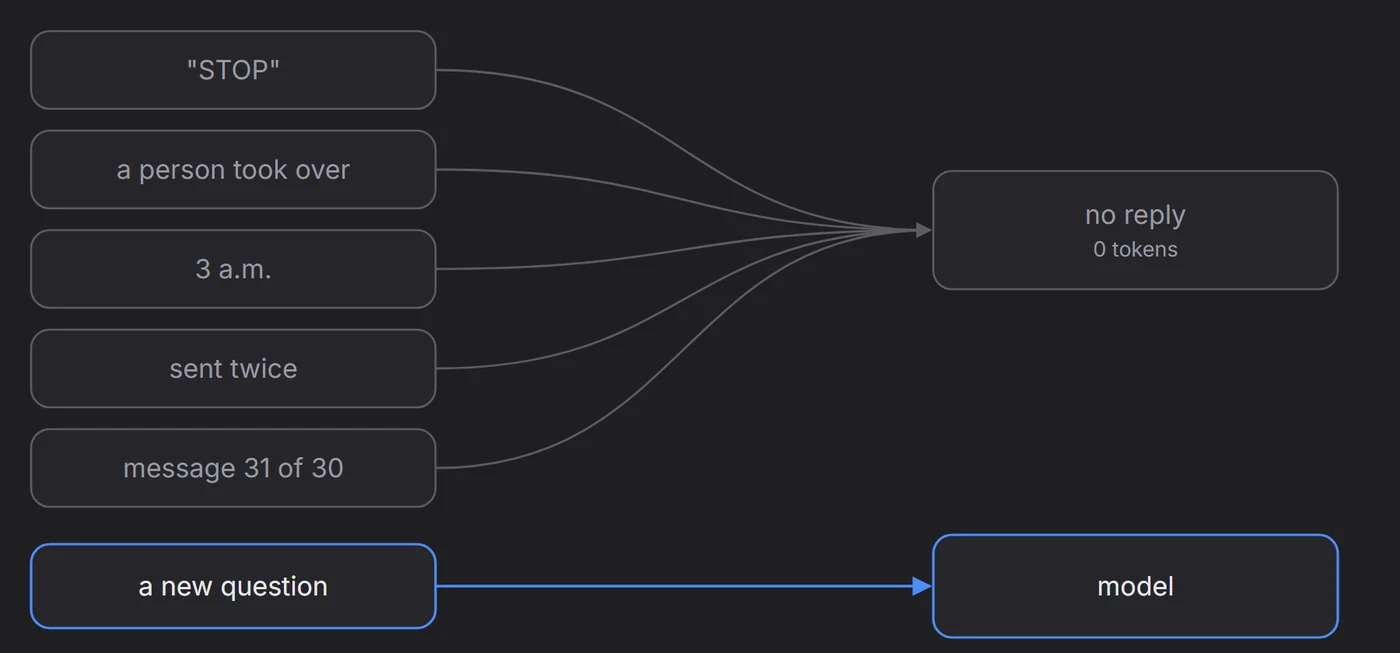
- When the customer has asked to stop: if someone texts STOP, UNSUBSCRIBE or “please stop messaging me”, the correct reply from the agent is no reply at all, beyond whatever confirmation the carrier rules require. That sounds obvious, but an agent that leaves this decision to the model can be talked into a polite farewell, a last-minute offer or, worst of all, a cheerful “No problem! Is there anything else I can help you with?”
- When a person has taken over: once someone on the team steps into a conversation, the agent should go quiet, including any follow-ups it had scheduled. Few things undermine a customer’s confidence faster than a manager writing a careful, personal apology, followed two minutes later by an automated message asking whether they’d still like to book. Treating a human takeover as a pre-check means the agent stops before it has even read the message.
- When it’s outside the hours it may reply: many businesses don’t want their agent answering at three in the morning, either because a reply at that hour feels strange or because the agent might promise something only a person can confirm. A reply schedule settles this before any model call, and the agent simply stays quiet until its hours begin.
- When the same message already arrived: networks retry, phones resend, and impatient customers tap the button twice. An agent that answers each copy separately ends up sending the same reply twice, or worse, booking the same appointment twice. A check that notices an identical message arriving within a short window can drop the duplicate before anything else happens.
- When the agent has said enough: most agents have a limit on how many messages they may send to one person, and once they reach it without an outcome, the right move is to stop and let the team decide what happens next. Customers who were interested are handed to a person, the rest are left alone, and nobody receives a fortieth message from an agent that never quite got the hint.
If you use a platform rather than build your own: ask whether these decisions are made by fixed rules before the model runs, or left to the instructions and the model’s judgement. The first kind behaves the same way every time, while the second can be argued with.
Waiting for the customer to finish
People don’t text in paragraphs. They send “hi”, then “quick question”, then “do you do Saturdays”, then “for a cleaning”, usually within about ten seconds and occasionally while the agent is already composing its answer to the first one. An agent that replies to every message as it arrives ends up having four overlapping conversations with one person, greeting them, asking what their question is, answering a question about Saturdays without knowing what it’s for, and then answering again once it does.
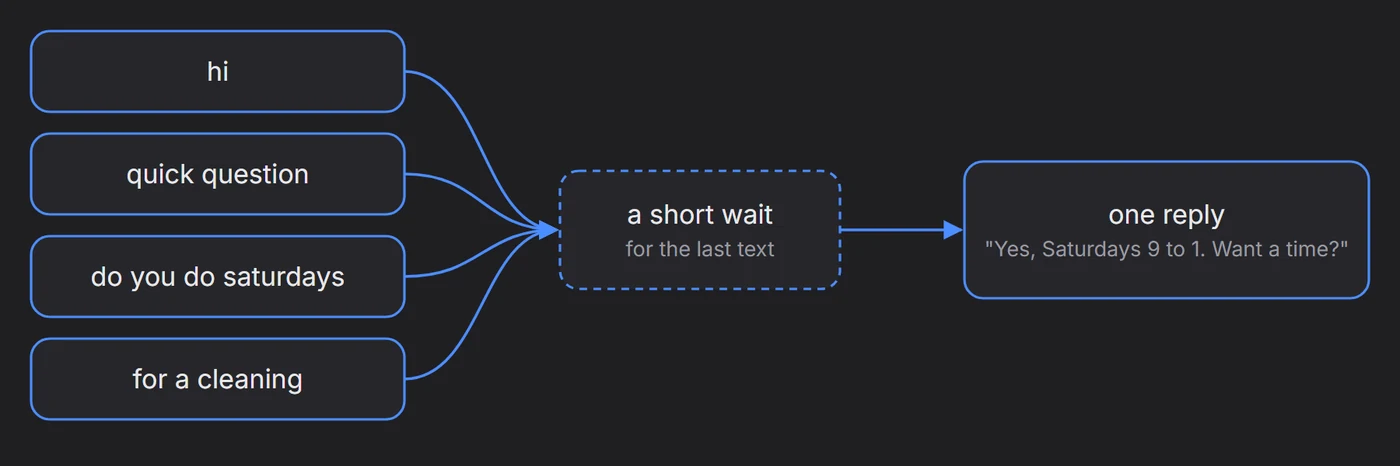
The fix is borrowed from ordinary human manners. Conversation researchers comparing ten languages found that the typical gap between turns in everyday speech is around 200 milliseconds, which means people start planning their reply long before the other person has finished, but they still wait for the other person to finish before speaking. A short response delay, a few seconds after the last message, lets the agent do the written equivalent. It waits until the customer seems to have finished, reads the four messages together as one request, and sends one answer, which in this case is a single line about Saturday cleanings and nothing else.
Saying less when it does reply
Even when a reply is needed, there are several habits that make it shorter without making it colder, and most of them come down to answering the question that was actually asked.
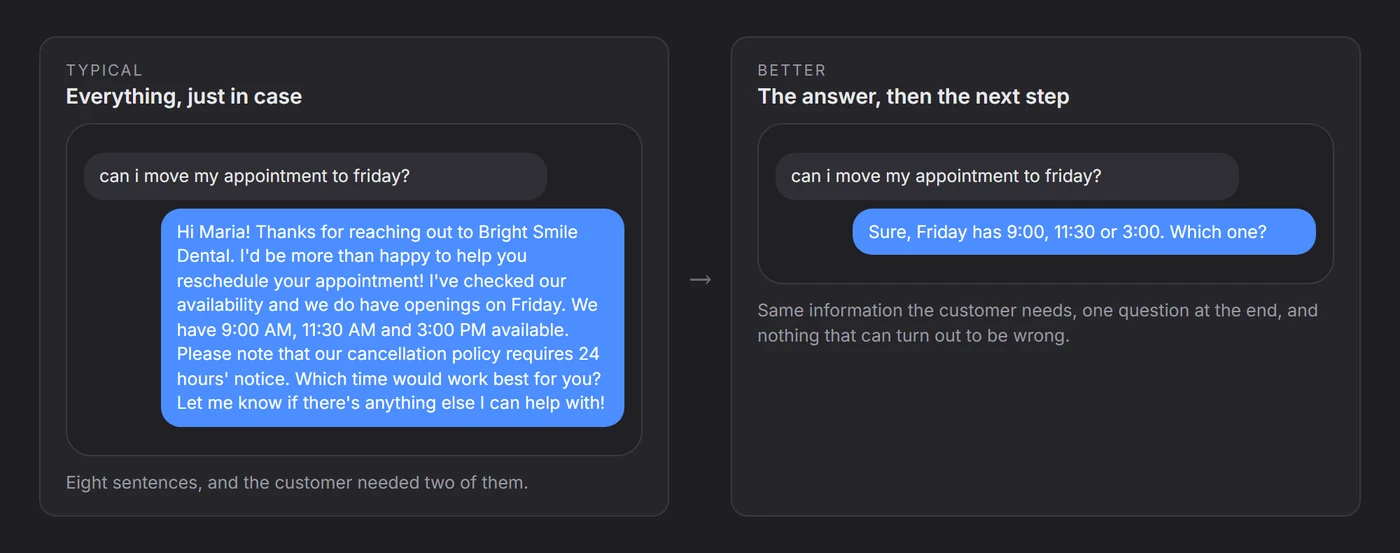
- One question at a time: an agent that needs a visit type, a preferred day and an email address will often ask for all three at once, in a message that looks like a form somebody has read aloud. Asking for one thing, waiting for the answer and then asking for the next feels much more like talking to a person, and customers are far more likely to answer a single question than to work through a list.
- No reintroductions: agents that greet the customer by name and introduce themselves in every message are surprisingly common, partly because each reply is generated with the instructions fresh in mind. Saying who you are once, at the start, is enough. In our own testing, this was one of the first corrections we found ourselves making, and it is the kind of thing an agent can be reminded of permanently once someone flags it.
- “I don’t know” is a complete answer: when an agent doesn’t have the information a customer asks for, the honest short reply is that it doesn’t have it, perhaps with a note about who does. The long reply, which pads the gap with general advice, related facts and a guess dressed up as a probability, is where most invented details come from, so permission to say “I don’t have that information” is also one of the most effective safety measures an agent can be given.
- Fit the channel: a reply that reads comfortably in a website chat window can feel like a letter when it arrives as a text message, and a reply that suits SMS can feel curt in an email. The same agent should write differently depending on where the conversation is happening, keeping texts short and splitting the occasional longer answer into two or three messages the way a person would.
- Don’t claim more than happened: the most damaging extra sentence an agent can write is a confirmation of something that didn’t succeed, such as “You’re all booked for Tuesday!” after the booking quietly failed. A check that compares the reply against what the tools actually reported can catch this, and when the claim can’t be supported, the right outcome is a shorter, true reply, or no reply until it can be.
A quick test for any agent: ask it a yes-or-no question and look at the first word of its reply. If that word isn’t yes or no, the answer is probably buried somewhere further down.
How to teach an agent to say less
Most of the work happens in the system around the model. If you are building or configuring an agent, these are the places to start.
| What to do | How it works |
|---|---|
| Move the decision to reply out of the model | Opt-outs, takeovers, quiet hours, duplicates and message limits should be fixed rules that run first. They are cheaper, they are consistent, and nobody can persuade them otherwise |
| Give the customer a few seconds | A response delay of five to ten seconds catches most bursts of short messages without making the agent feel slow |
| Ask for one thing at a time | Required questions work better as a sequence than as a list |
| Write length into the instructions and the persona | ”Answer the question first, in one or two sentences” is more effective than “be concise”, which every model believes it already is |
| Let the agent admit what it doesn’t know | Say so explicitly in the instructions, because without permission most models will fill the gap |
| Correct long replies when you see them | If your platform lets you save corrections, a few examples of the shorter reply you wanted go a long way, since the agent can look them up the next time a similar message arrives |
| Count messages per outcome | If booking an appointment takes an agent fourteen messages and your best receptionist does it in six, the gap is usually length and repetition, and it is easy to see once you measure it |
How Myna handles it: Myna’s agents are built to work this way by default. The checks for opt-outs, takeovers, reply hours, duplicates and message limits run before the model is called, a ten-second response delay groups a customer’s messages into one turn, and corrections saved while testing an agent in the Playground are looked up again before it replies to a similar message.
Where this leaves conversational AI
Conversational AI spent its first few years trying to prove it could talk, and it succeeded so thoroughly that talking is now the least impressive thing it does. The agents that customers come to trust are the ones that behave like a good receptionist, who answers the question you asked, waits while you finish your sentence, tells you plainly when they don’t know, and puts the phone down when you say goodbye.
None of this requires a cleverer model. It requires deciding, deliberately and mostly outside the model, when the agent should speak and how much it should say, and then reading enough real conversations to check that it does. The Spartans managed it with one word, and a well-built agent rarely needs to be quite that brief, but it should at least know that the option exists.