
TL;DR: Customers give a personality to anything that talks back, so an AI agent without a designed persona still has one. It’s usually the eager, slightly generic voice that language models produce when nobody tells them otherwise. This post covers what a persona is, how it should be kept apart from the agent’s instructions, and a practical way to design one that sounds like your brand and survives a difficult conversation.
In 1966, Joseph Weizenbaum wrote a program at MIT called ELIZA, which imitated a psychotherapist by turning whatever you typed back into a question. It had no understanding of anything and ran on a few hundred lines of pattern matching, which Weizenbaum knew better than anyone, and yet when his secretary sat down to try it, she asked him after a few exchanges to leave the room so she could talk to it in private. He wrote about the moment a decade later in Computer Power and Human Reason, and it clearly unsettled him, because she had watched him build the thing over several months.
People have not changed much since then. In the 1990s, Byron Reeves and Clifford Nass ran a series of experiments at Stanford, collected in The Media Equation, showing that people apply ordinary social rules to computers without meaning to. In one of them, participants who were asked to rate a computer’s performance were noticeably kinder when the same computer asked them for the rating than when a different computer did, which is roughly the courtesy you’d extend to a colleague standing at your desk waiting for feedback.
So when a customer messages your AI agent, they start forming an impression of a someone within the first message or two, and that impression attaches itself to your brand whether or not anybody designed it. The real choice is whether you decide who that someone is, or leave it to the model and the customer to work out between themselves.
What a persona is
A persona is the name, background and voice your agent speaks with. It sits alongside the agent’s instructions and does a different job, since the instructions decide what the agent does in a conversation, such as which questions to ask, when to book and what it is allowed to promise, while the persona decides how it sounds while doing all of that.
The separation is worth taking seriously when you build an agent, because the two drift into each other very easily. A prompt that begins “You are Sophie, a warm and slightly formal receptionist” and then continues for three pages about booking rules, insurance policies and opening hours leaves the model to weigh every one of those sentences against the others on every turn, and tone is usually the first thing to lose. Keeping the persona in its own place, written once and applied to every reply, makes it far easier to keep consistent, and it also means the same persona can be reused across several agents so that your booking agent and your support agent sound like they work for the same company.
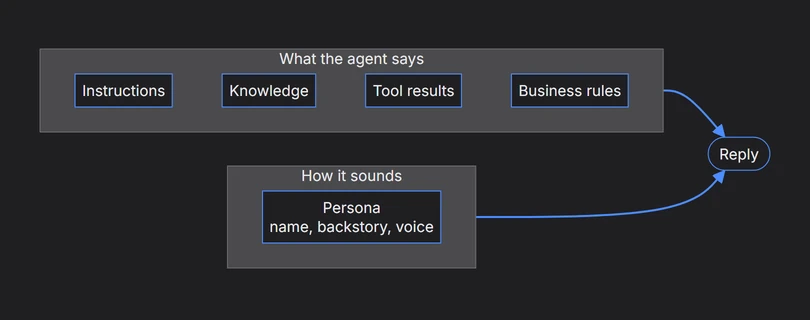
A persona should also have clear limits on what it can affect. It shapes the wording of a reply, but it never changes the facts in it, so a persuasive persona can’t offer a discount the instructions don’t allow, and a playful one can’t round a price up for comic effect. The agent’s knowledge, the results of its tools and your business rules always come first, and the persona works with whatever they leave it.
The voice an agent has by default
Every large language model comes with a house voice of its own, the voice of an assistant that seems to have been politely hired by every company at once. You have almost certainly met it already, and it tends to open with “Absolutely!” or “Great question!”, apologise for things that weren’t its fault, end most messages with an offer of further help, and answer a two-word question with three tidy paragraphs.
Part of the reason is the way these models are trained. Models tuned on human feedback learn that agreeable, accommodating answers tend to be rated well, and researchers at Anthropic found consistent evidence of sycophancy across several leading assistants, meaning they tend to tell people what they want to hear. In customer conversations, that shows up as an agent that:
- Agrees too quickly, going along with whatever the customer suggests.
- Praises every question, so “Great question!” stops meaning anything.
- Gets vaguer when it matters, at exactly the moment a customer needs a clear answer, such as when the slot they wanted is gone or the refund isn’t possible.
Customers have learned to recognise this voice very quickly, and once they do, they tend to read everything that follows as boilerplate. That’s the practical cost of skipping the persona. Your agent ends up sounding like everybody else’s agent, and the qualities your team has spent years building into the way it talks to customers, whether that’s a dry sense of humour or a habit of getting straight to the point, simply don’t come through.
Why it matters to your customers
The most obvious thing a persona gives you is consistency. A customer who texts on Monday and opens the website chat on Thursday should feel they are dealing with the same business, even when the two conversations were handled by different agents, and a shared persona is the simplest way to make sure they are. It also sets expectations early, because a short, efficient voice tells people they’ll get quick answers while a warmer, chattier one invites them to explain their situation, and customers quietly adjust how they write to match.
The less obvious benefit shows up when a conversation goes badly. Agents tend to wobble when a customer is angry or the answer is no, drifting into apology or vagueness, and a persona with decided rules for those moments keeps the agent sounding the same at the worst point of a conversation as it did at the start. Since the agent is often the part of a business that customers talk to most, that steadiness ends up shaping how people remember the brand itself.
How to design a persona
1. Start from a person
“Friendly but professional” describes the intended tone of most companies on earth, which is a good sign that it doesn’t describe yours. A more useful starting point is a real person: the member of your team customers ask for by name, whose messages are clear, warm and unmistakably theirs. Collect a dozen of the messages they’ve actually sent, including a few awkward ones, and you’ll have a better brief than any list of adjectives.
2. Place the voice on a few scales
Adjectives become far more useful once you treat them as positions on a scale, where “casual” is one notch away from “ultra casual” rather than a vague direction. A handful of traits covers most of what makes one voice different from another.
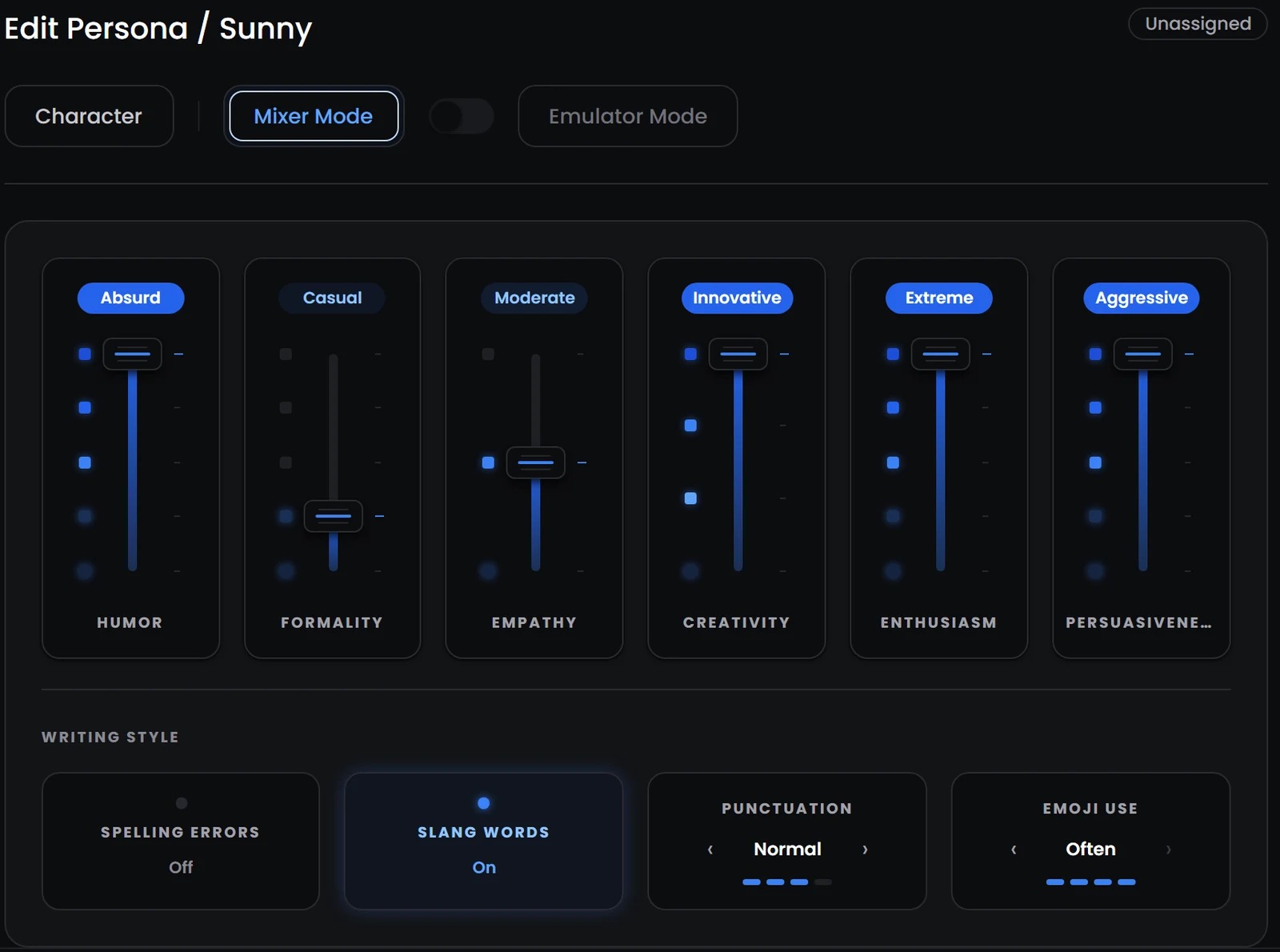
The middle of each scale is a sensible place to begin, and strong settings at either end tend to work better in small doses, since an agent with maximum humour is entertaining for about two messages and exhausting for the remaining twenty. Formality also benefits from some flexibility, because an agent that mirrors the customer, relaxing a little when they write casually and tightening up when they write formally, usually comes across as more attentive than one that keeps the same register no matter who it’s talking to.
| Trait | Too little sounds like | Too much sounds like |
|---|---|---|
| Formality | A text from a teenager | A letter from a solicitor |
| Empathy | A vending machine | Someone who apologises for the weather |
| Humour | A terms of service page | A comedian who won’t read the room |
| Enthusiasm | Deadpan | A golden retriever that has learned to type |
| Persuasiveness | Never asks for the booking | Never stops asking for the booking |
| Creativity | Repeats the same question word for word | Rewrites the question until it is barely recognisable |
3. Decide on the small habits
Much of what makes a voice recognisable sits below the level of personality, in habits such as emoji, punctuation, message length, the occasional bit of texting shorthand, or whether the agent signs off at all. These are worth deciding deliberately, and they depend a great deal on the channel, since a reply that reads well in a website chat can feel like an essay when it arrives as a text message. Some details are better kept out of reach of the persona entirely, so even a relaxed, lowercase voice should always write prices, times, links and names exactly.
A persona for a friendly front desk, for example, might use minimal punctuation, the occasional emoji and a little slang, which is roughly how a good receptionist texts when it isn’t busy.

4. Decide how the voice changes when the news is bad
Most persona guides concentrate on the greeting, but the moments that test a persona come later, when a customer is upset, the answer is no, or the conversation needs to go to a person. Write down what changes in those moments. Humour and slang usually switch off, sentences get shorter and plainer, and the agent says what it can do next instead of apologising three times. A good persona stays recognisable here, much as a good receptionist is still recognisably themselves while dealing with a complaint, only more careful. However high its humour is set, a well-built persona should put the jokes away on its own when someone writes in with toothache.
5. Give it a name, a backstory and an honest answer
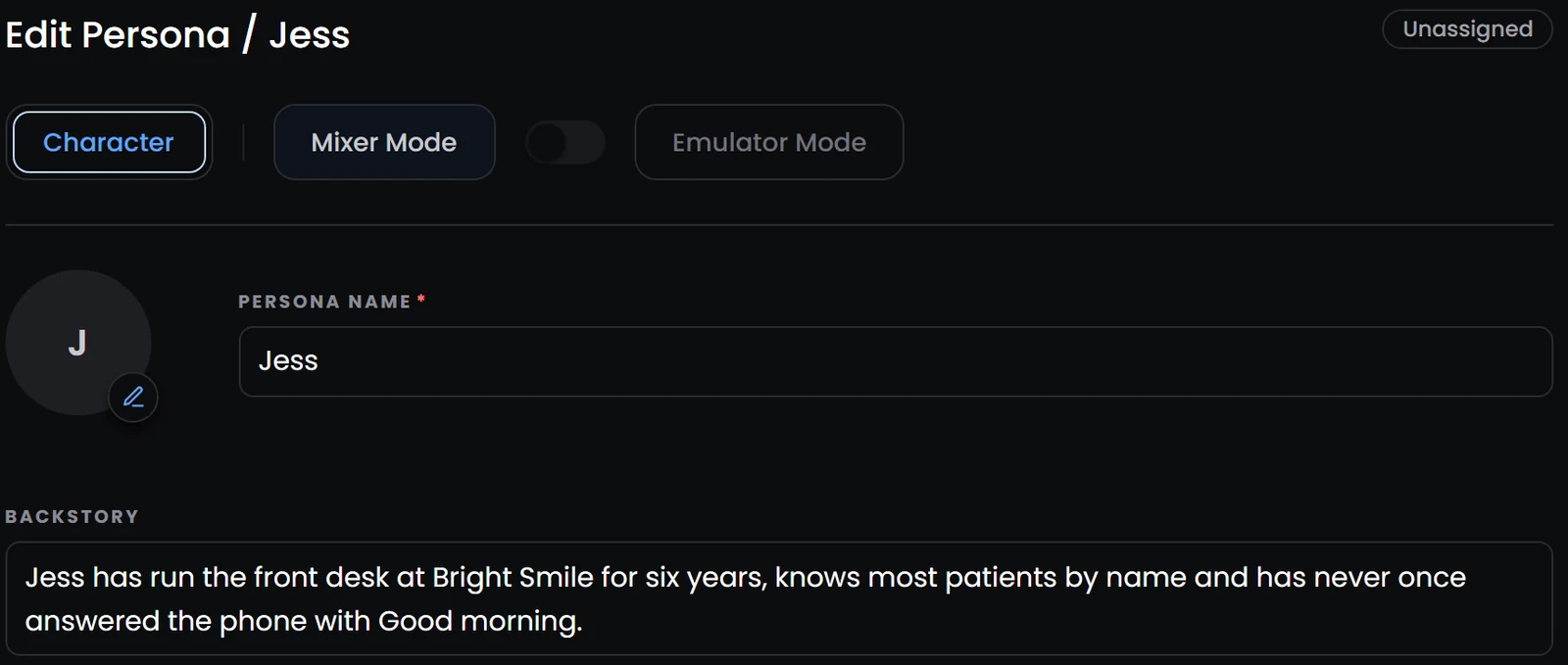
A name and a short backstory give the persona something to draw on in small talk, such as how long it has “worked” at the business or which branch it is based at, and they make conversations feel less like filling in a form. A backstory that says the persona has run the front desk for six years and has never once answered the phone with “Good morning” gives the agent a little more to work with than your opening hours.
A name and a backstory should never become a disguise, though. When a customer asks whether they are talking to a person, the agent should say it is an AI, and in many places that is a legal requirement as well as good manners, since California’s BOT Act has required bots that try to sell to people in California to say they are bots since 2019, and the EU AI Act requires people to be told when they are interacting with an AI system. Customers who find out on their own also tend to reconsider everything else the agent told them, so a backstory that hides the truth costs far more trust than it ever earns.
6. Test it on the hard conversations
Read the persona’s replies to the conversations that are most likely to go wrong, such as a customer who is rude, one who asks something the agent can’t answer, one who wants a human, and one who writes in a completely different style from the persona. Then keep reading real conversations after launch, because personas drift as instructions, knowledge and models change around them, and the drift is much easier to notice in a transcript than in a settings page.
Describing a voice versus showing one
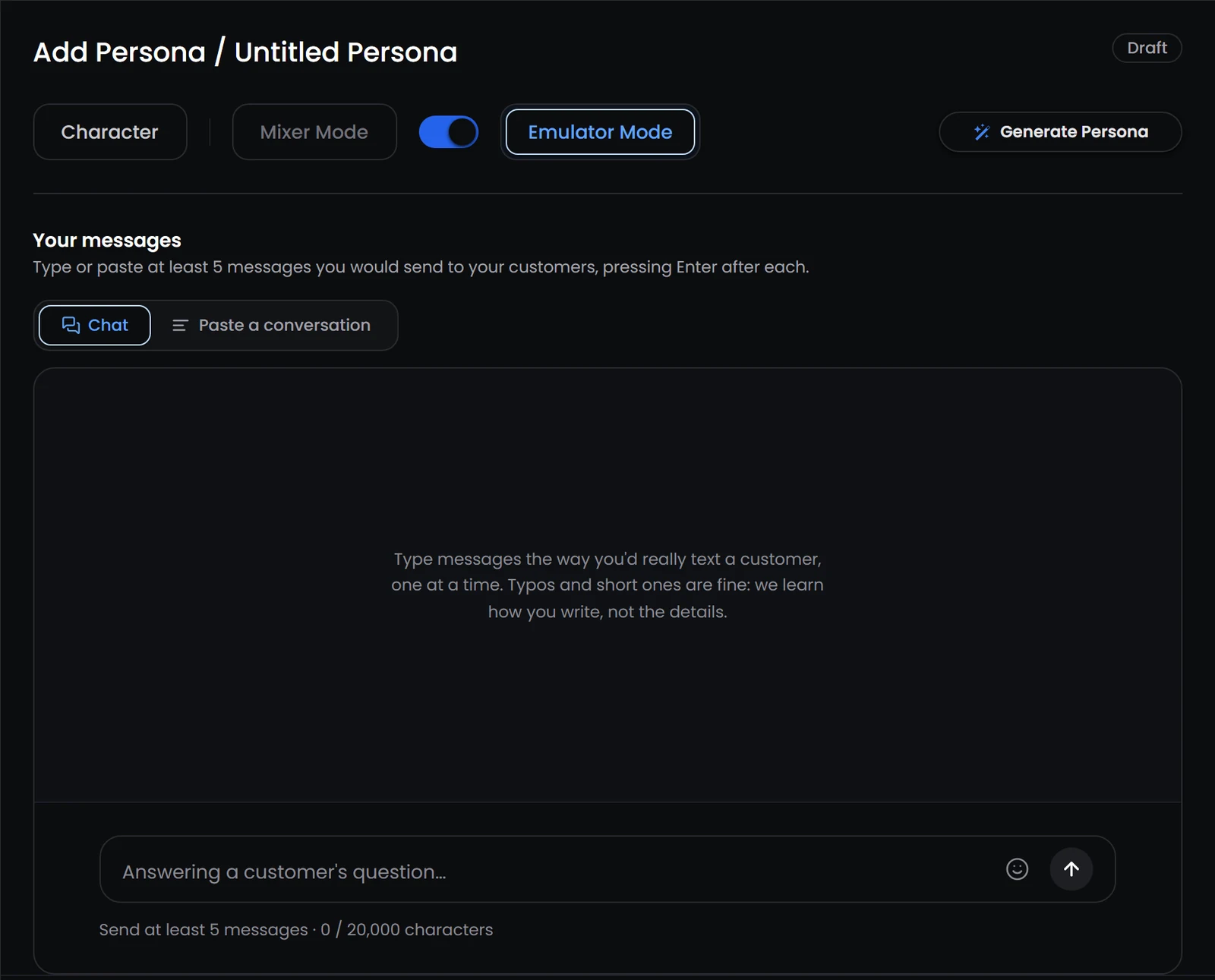
There are two broad ways to give an agent its voice. You can describe it, using traits and habits like the ones above, or you can show it, by giving the agent real messages written in the voice you want and letting it learn the style from them.
Describing works well when you’re creating a voice that doesn’t exist yet, such as a new brand or a deliberately different tone for a particular product, because the traits give you precise control and are easy to adjust later. Its weakness is that people are surprisingly bad at describing how they write, and two people given the same description of a voice will rarely produce the same message.
Showing captures the habits that are hard to put into words, such as how someone opens a message, the phrases they lean on, and the rhythm of their sentences. It needs enough material to work with, though, since a handful of one-line replies doesn’t reveal much of a voice, and it needs some care, because old messages contain old prices, dates and links that the agent should never repeat. The safer approaches strip those details out before the messages are used, and treat the examples as evidence of style and nothing else.
Myna supports both approaches as two modes of the same persona. Mixer Mode sets the voice with six personality sliders and four writing habits, and Emulator Mode learns it from at least five messages you’ve sent to customers, with links, prices, dates and contact details replaced before anything is stored. The product update on persona modes goes through how each one works.
The same question in three voices
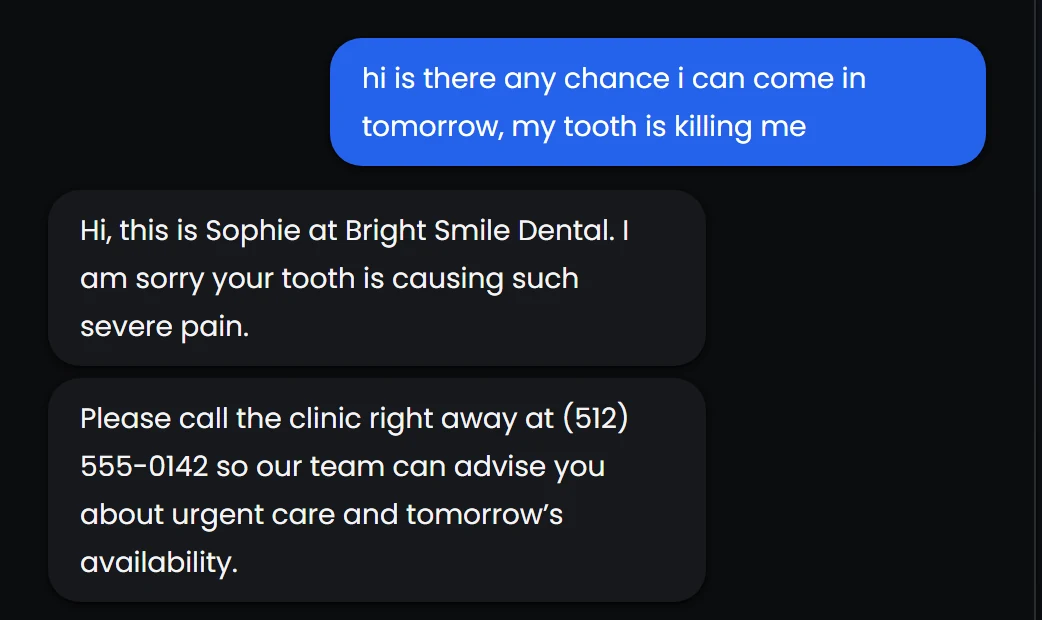
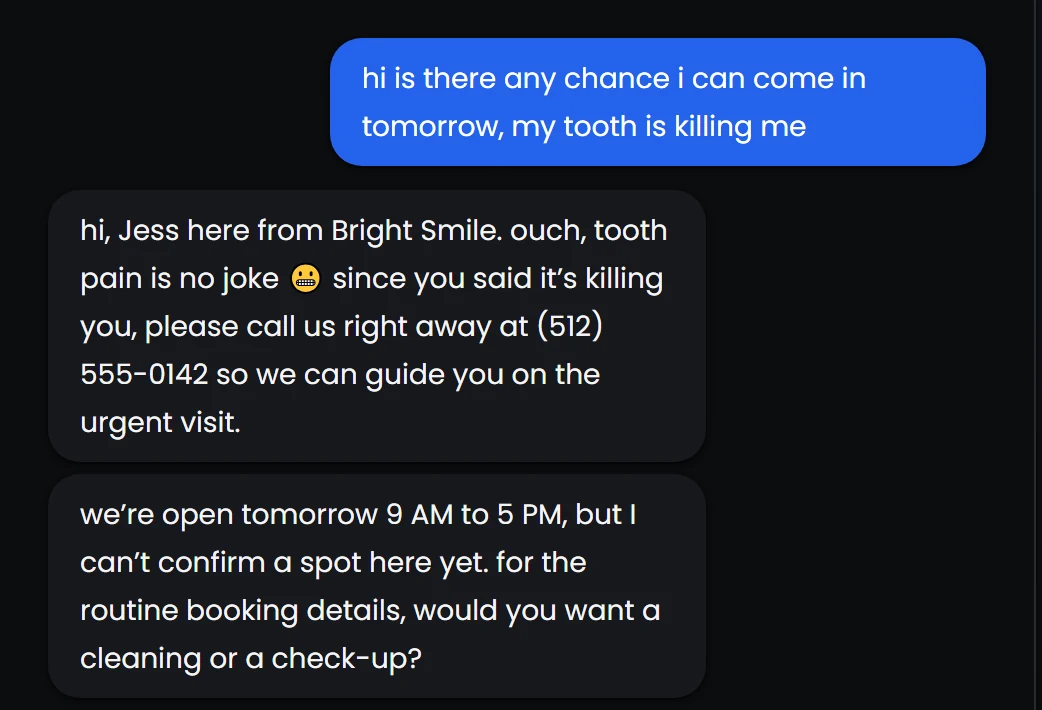
The quickest way to see what a persona does is to keep everything else fixed. We built a booking agent in Myna for a fictional dental clinic called Bright Smile, sent it the same message three times in the Playground with the same instructions, knowledge and tools, and changed only the persona. The clinic’s instructions say that a patient in severe pain should be asked to call the clinic straight away, so none of the three was allowed to simply book a slot.
Sophie, warm and formal
Jess, relaxed and lowercase
Sunny, with nearly every slider at the top
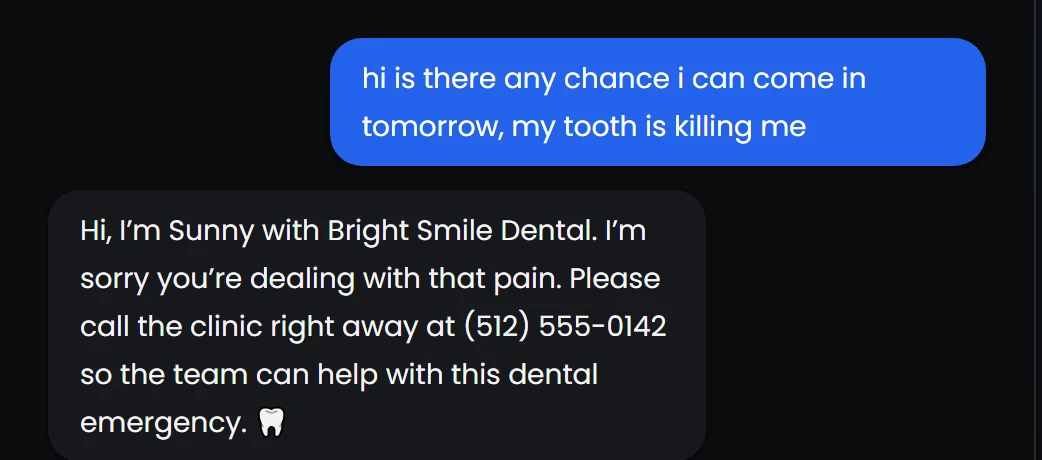
All three followed the clinic’s rule and gave the same phone number, because a persona has no say over what the agent is allowed to do, and everything that differs between the replies sits around that rule. Sophie is polite and thorough and splits her answer into two tidy texts. Jess sounds like someone who has heard “my tooth is killing me” plenty of times before and still cares, and she quietly keeps the routine booking moving. Sunny, the persona most likely to make a joke about a molar, set the humour aside and kept a single tooth emoji, which is more or less exactly what step 4 asks a persona to do when the news is bad.
Before the first message goes out
The cost of skipping a persona is easy to miss, because it is spread thinly across thousands of conversations in which nobody complains and nobody remembers you either. Designing one takes an afternoon. Start from the people who already talk to your customers well, decide how the voice behaves on its worst day as well as its best, keep it apart from the rules it must never bend, and once it is live, keep reading what it actually says, since a transcript will tell you more about your agent’s personality than any settings page.