
TL;DR: Agentic customer experience, often shortened to ACX, is what customer service looks like when AI agents can act as well as talk, booking, updating, refunding and escalating inside the conversation. It is built on conversational AI, but it adds tools that change things, memory that persists, rules that are enforced outside the model, and people who supervise. This post explains what ACX is, the layers it’s made of, and what “enterprise-grade” actually means in practice, which turns out to describe how carefully the system around the agent is built, whatever the size of the company using it.
When banks first installed cash machines in the late 1960s, the machines could do exactly one thing, which was hand over money. You couldn’t check your balance, pay a bill or deposit a cheque, and for anything beyond a withdrawal you still had to queue for a person behind the counter. Over the following decades, the machines gradually took on more of the work, until most routine banking could be done without ever speaking to anyone, and the people behind the counter moved on to the parts of the job that genuinely needed them.
Customer service is going through a similar change, and much faster. For most of the past decade, the automated part of customer experience could answer questions and route people to the right department, but anything that changed something, such as a booking, a refund or an address, had to go to a person. Agentic AI moves that line, because an agent can now do the work itself, inside the same conversation in which the customer asked for it.
The industry has started calling the result agentic customer experience, or ACX. Like most new terms, it’s used loosely, so this post tries to pin down what it means, what it’s made of and what separates a solid implementation from a fragile one.
From answering to acting
The easiest way to understand ACX is to look at how automated customer service has evolved over roughly three stages.

| FAQ bots | Conversational AI | Agentic customer experience | |
|---|---|---|---|
| Understands | Keywords and button clicks | Natural language, including messy and multi-part questions | Natural language, plus the customer’s history and context |
| Answers from | Fixed scripts | The business’s knowledge | The business’s knowledge and live systems |
| Can change things | No | Rarely | Yes, through tools such as booking, ticketing and CRM updates |
| Measured on | Deflection | Questions answered | Outcomes, such as bookings and resolutions |
| Typical failure | ”Sorry, I didn’t understand that” | A confident wrong answer | An action taken that shouldn’t have been |
The last row of the table matters most. Each stage fails in a characteristic way, and the failures get more consequential as the agent gets more capable. A bot that doesn’t understand you is irritating, while an agent that refunds the wrong order is expensive, so most of what makes agentic customer experience work well is about controlling that last kind of failure.
The layers of an agentic customer experience
An agentic customer experience is made of several layers working together, and the conversation the customer sees is only the top one.
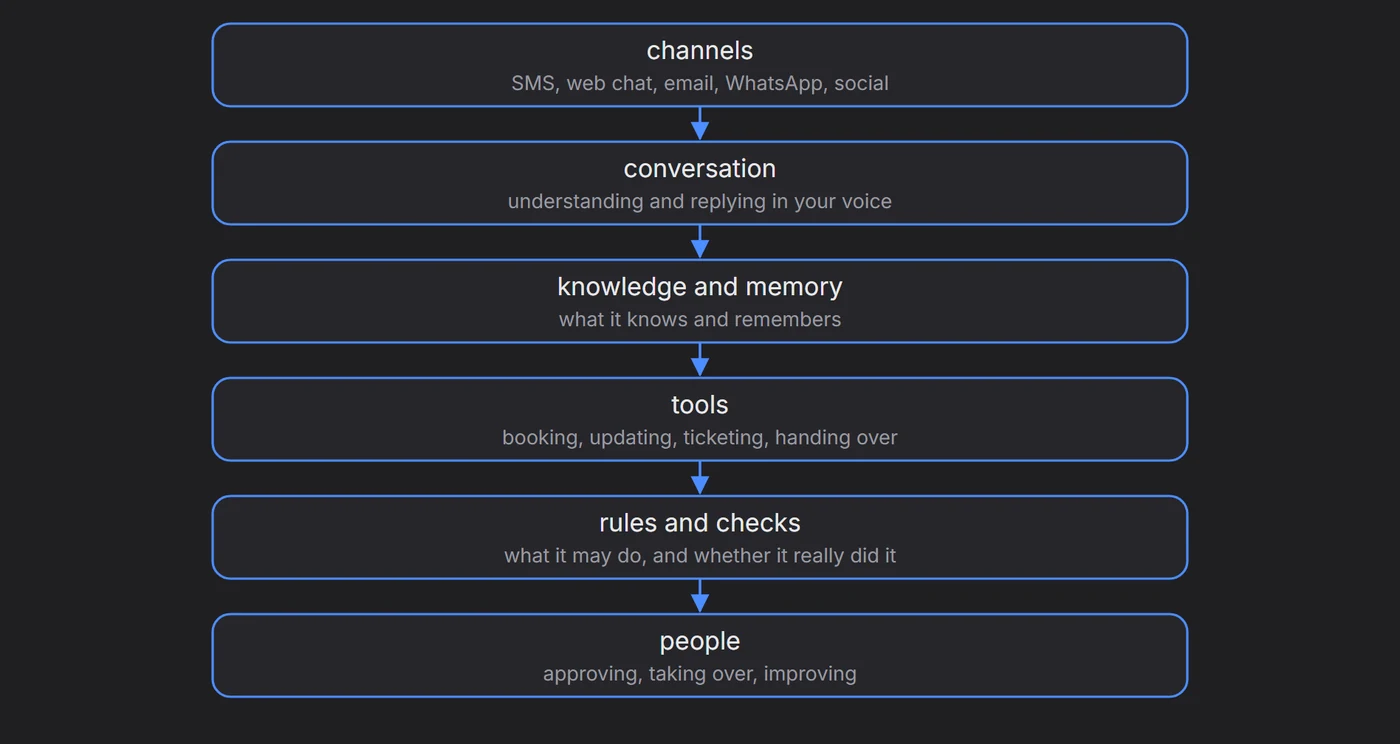
Channels: where the customer reaches the business, such as SMS, web chat, email, WhatsApp or social messaging. In a well-built system, these all lead to the same agent, with the same history, which is what omnichannel customer experience means in practice.
The conversation: conversational AI understands what the customer wants, keeps track of what has been said, and replies in the business’s voice, which is usually set by a persona kept separate from the agent’s instructions.
Knowledge and memory: what the agent knows about the business, searched when a question needs it, and what it remembers about the customer, such as earlier conversations, preferences and the details they’ve already given.
Tools: the actions the agent can take, such as checking availability, booking an appointment, updating a contact, opening a ticket or handing the conversation to a person. Tools are what make the experience agentic, and they are also where most of the risk lives.
Rules and checks: the system around the model, often called a harness, which decides whether the agent should reply at all, which tools it may use on a given turn, and whether what it says matches what actually happened.
People: the team that approves sensitive actions, takes over conversations that need a human, and corrects the agent so it improves.
Worth noticing: only one of these layers is the language model. Most of what determines whether an agent can be trusted with customers is built around it.
What “enterprise-grade” actually means
“Enterprise-grade” is one of the most overused phrases in software, and it’s often taken to mean “built for large companies”. In agentic customer experience, it’s more useful to treat it as a description of how the system behaves, since a small clinic and a national bank need most of the same guarantees, just at different volumes.
- Predictable: given the same situation, the agent behaves the same way. Decisions that have a right answer, such as whether a customer opted out, are made by fixed rules instead of the model’s judgement.
- Permissioned: the agent can only use the tools it has been given, and only when the conversation allows it. A booking tool might stay unavailable until the required questions are answered.
- Verified: what the agent tells the customer is checked against what its tools actually reported, so it can’t claim a booking, refund or change that didn’t happen.
- Recorded: every turn and every action is logged, with what went in, what came out and which checks fired, so anyone can find out later why something happened.
- Private: customer data is only used for what the customer would expect, personal details are protected, and the agent only sees the fields it needs.
- Supervised: sensitive actions can require a person’s approval, and a person can take over any conversation, at which point the agent stops completely.
- Testable: the agent can be tried against realistic and difficult conversations before it goes live, and every change can be tested before customers see it.
- Honest: the agent says it’s an AI when asked, doesn’t pretend to know what it doesn’t, and makes it easy to reach a person.
None of these depends on the size of the business. They describe whether the agent can be trusted with a customer, which is a question every business has to answer, whether it handles fifty conversations a week or fifty thousand.
Where the work moves
One of the more interesting effects of agentic customer experience is what it does to the people behind it. When agents take over routine bookings, questions and updates, the team’s work doesn’t disappear, but it changes shape.
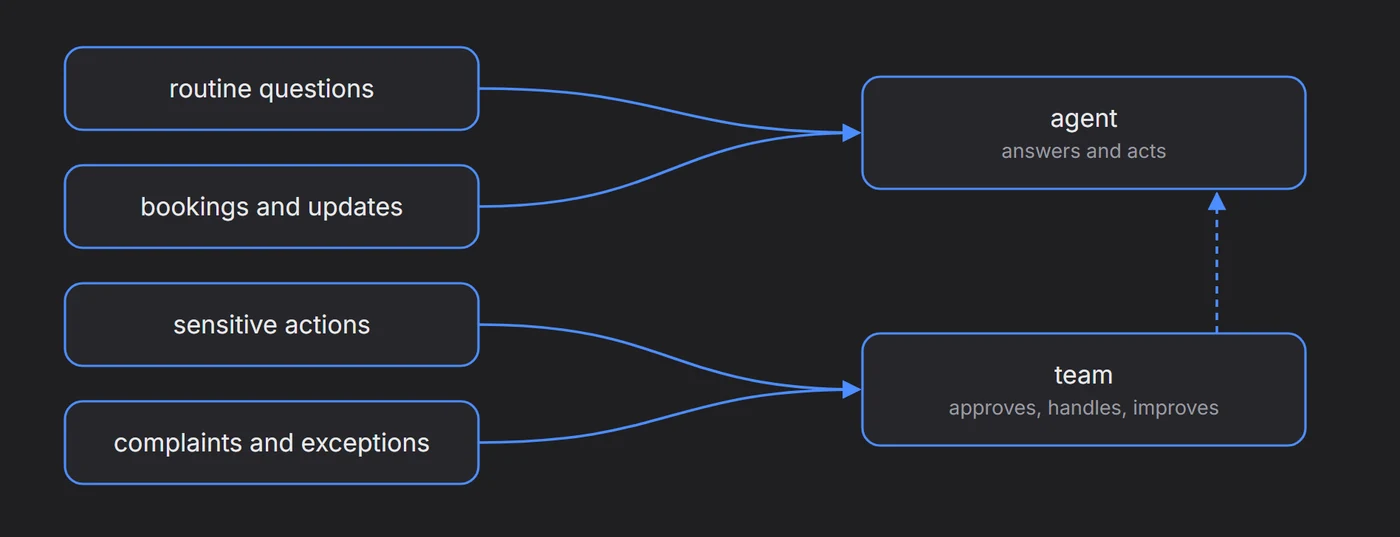
Instead of answering the same questions all day, people spend more of their time on conversations that need judgement, empathy or authority, such as complaints, exceptions and complicated cases. They approve actions the business wants a person to sign off, and they review conversations to improve the agent’s knowledge, rules and tone. The job becomes less like working a switchboard and more like supervising and coaching a capable new colleague.
This is also where many implementations stall. An agent that nobody owns slowly drifts out of date, as prices change, services are added and the knowledge base falls behind, so a business that wants agentic customer experience to keep working needs someone whose job includes reading conversations and making the agent better.
Enterprise-grade without an enterprise team
For most of the past decade, the guarantees above were only available to large companies, because building them meant engineering teams, integration projects and months of testing. That is changing, mostly because the hard parts, such as the rules around the model, the verification of claims, the logs and the handoff to people, can be built into the platform the agent runs on instead of being rebuilt by every business that uses it.
That leaves each business to focus on the parts only it can provide: what it knows, what it allows, how it sounds and who on the team supervises. Those are the parts that make an agent feel like it belongs to that particular business, and they’re also the parts that no platform can supply on its own.
In Myna: the checks around the model are built in, so opt-outs, takeovers and quiet hours are handled before the model runs, replies are compared with what the tools reported before they’re sent, and every conversation from every channel sits on the contact’s record. Businesses supply the knowledge, the instructions, the persona and the calendars, and test the agent in the Playground before it goes live.
The cash machine moment
The early cash machines didn’t replace bank tellers overnight, and for a long time they did very little. What they changed was the expectation of what could be done without waiting for a person, and once that expectation shifted, it didn’t shift back.
Agentic customer experience is at a similar point. Customers are starting to expect that the conversation in which they ask for something is also the conversation in which it gets done, and the businesses that meet that expectation well will be the ones that treat the agent as part of their operation, with clear permissions, reliable checks and people who look after it, instead of a clever chat window bolted onto the side of the website.