
TL;DR: The odds of turning an enquiry into a customer fall steeply within the first hour, and most enquiries that arrive in the evening wait until the next morning. An autoresponder fills that gap with a polite receipt. An agentic AI fills it with the actual work: it answers the question, asks what it needs to know, checks the calendar and books the appointment while the customer is still holding their phone. This post explains why the first minutes matter so much and what happens inside those minutes when an agent handles them.
Around 1910, a large city telephone exchange would have looked much like the photograph below: long rows of operators seated at switchboards, each of them connecting calls by hand, with a supervisor walking behind them to make sure nobody was left waiting. Telephone companies took waiting seriously. Operators were expected to answer within seconds of a light appearing on the board, and exchanges were staffed through the night, because a caller who heard nothing for long enough simply hung up and tried again later, if they bothered at all.
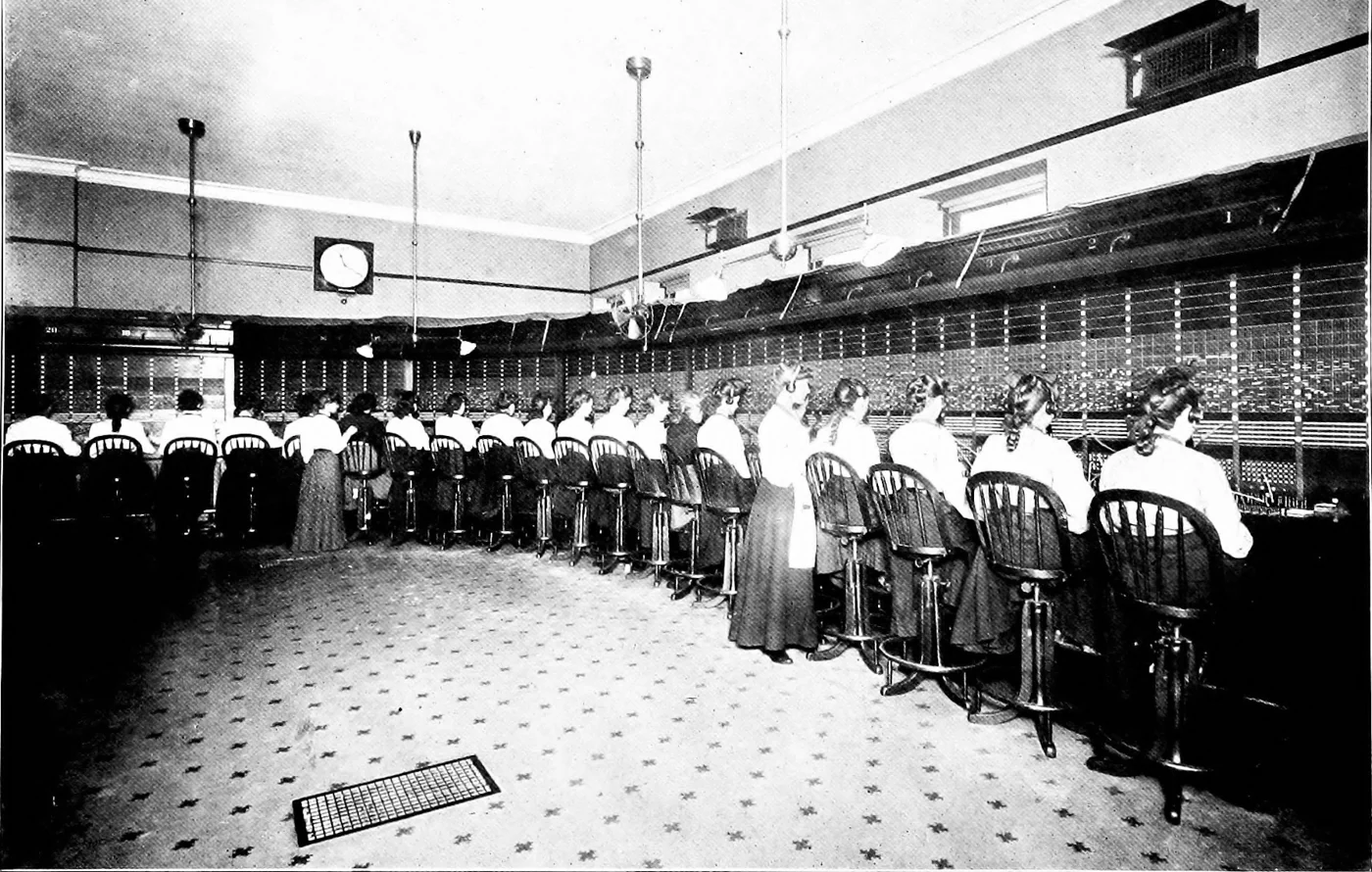
A century later, most businesses answer their enquiries far more slowly than an Edwardian telephone exchange answered its calls. A message sent through a website form at 9:47 on a Tuesday evening typically sits untouched until someone opens the inbox the next morning, by which time the person who sent it has usually contacted two other businesses, booked with whichever replied first, and forgotten that they ever wrote to the third.
This is the problem that sales teams call speed to lead, and it is one of the places where agentic AI has made the most practical difference, mostly by doing something quite unglamorous, which is answering properly at a time of day when nobody else is.
Why the first minutes matter
The research on lead response is unusually consistent. When Harvard Business Review audited 2,241 US companies in 2011, it found that businesses which tried to contact a web lead within an hour were nearly seven times more likely to qualify it than those that waited even one hour longer, and that the average company took 42 hours to respond at all. An earlier study of more than 15,000 leads by James Oldroyd and InsideSales.com found that the odds of reaching a lead fell dramatically between five minutes and thirty, which is a remarkably short window for a decision that most businesses make the next day.
The reasons are not mysterious. Someone who fills in an enquiry form is paying attention to their problem at that moment, whether it’s a broken boiler, a chipped tooth or a kitchen they’ve finally decided to redo, and their attention is the scarcest thing in the whole transaction. Within an hour, they have usually moved on to dinner, to another tab, or to a competitor who replied first, and the enquiry that seemed urgent at 9:47 feels much less so at 9:15 the following morning.
Emergency medicine has a name for a similar idea. Trauma surgeons talk about the “golden hour”, the period after an injury in which treatment makes the greatest difference, and the phrase has become shorthand for the idea that some problems are far easier to solve early than late. The comparison has its limits, since nobody’s life depends on whether their gutters get quoted on Tuesday or Wednesday, and even in medicine the exact hour is debated. But the shape is the same, because interest, like a lot of things in the body, decays quickly at first and slowly afterwards.
For more on the numbers: the two studies are often confused with each other. The Hidden Cost of Slow Lead Response untangles them, and Why Businesses Lose Leads After 5 PM looks at why evening enquiries are often the most valuable ones.
Why an autoresponder falls short
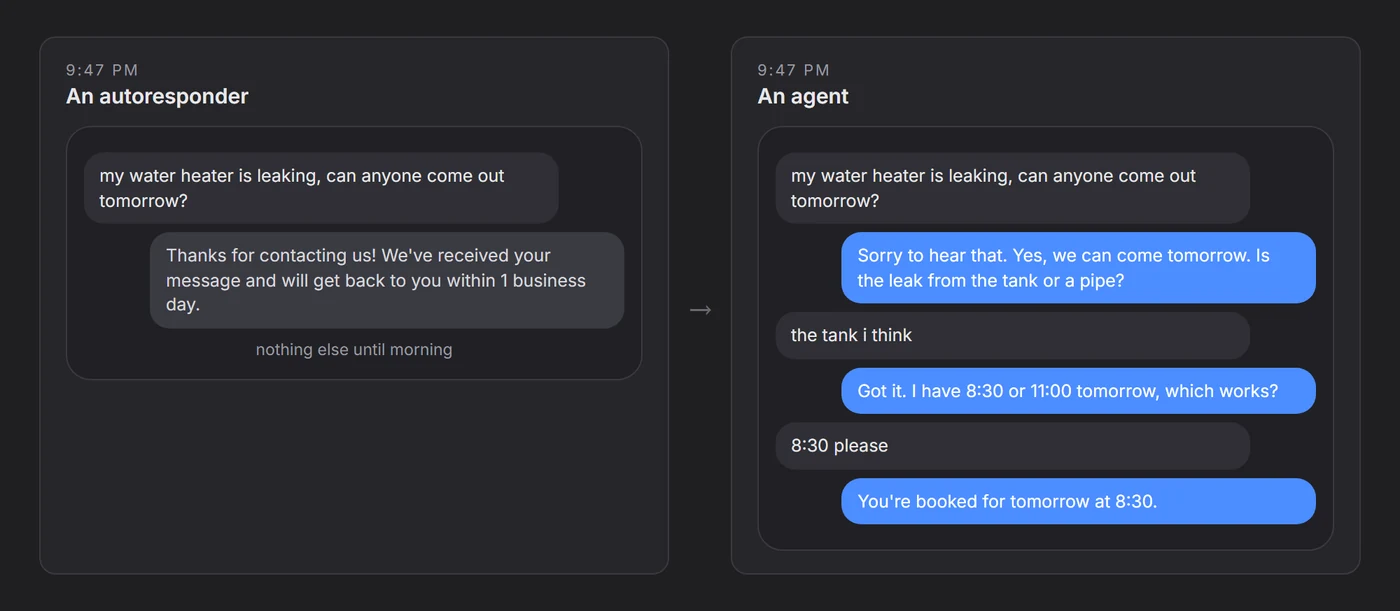
The traditional answer to after-hours enquiries has been the autoresponder, a message that goes out instantly to say that the business has received the enquiry and will be in touch soon. It satisfies the letter of a fast response, since the customer hears something within seconds, but very little of its spirit, because nothing about their problem has moved forward. They still don’t know the price, they still don’t have an appointment, and “we’ll be in touch soon” reads to most people as a polite way of saying “not tonight”.
An agentic AI approaches the same moment differently, because it can act as well as reply. It can read what the customer actually asked, answer it from the business’s own information, ask the one or two questions it needs, check which times are genuinely free and book the appointment in the same conversation, so that the lead is handled while the person who sent it is still holding their phone.
Inside the first five minutes
It helps to follow a single enquiry to see what the agent is actually doing. Suppose a homeowner texts a plumbing company at 9:47 on a Tuesday evening to say that their water heater is leaking and to ask whether anyone could come out tomorrow.
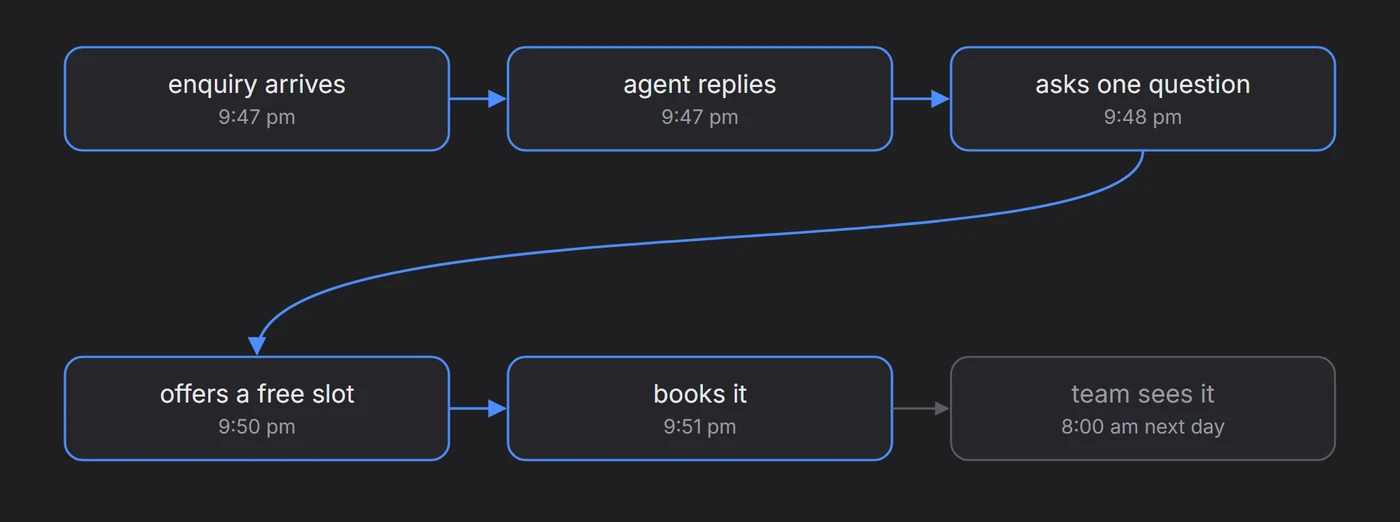
- The agent waits a few seconds: people rarely say everything in one message, so a short response delay lets the homeowner finish typing before the agent starts, and if they send a photo and a second message, the agent reads all of it together.
- It answers the question that was asked: the homeowner wants to know whether someone can come tomorrow, so that’s what the agent addresses first, using the company’s real service area, hours and policies from its knowledge base, without inventing a price it doesn’t have.
- It asks only what it needs: if the company needs an address and whether the leak is from the tank or a pipe before it books, the agent asks for those, one at a time, and doesn’t ask again for anything the homeowner already said.
- It offers a time that is actually free: the agent checks the calendar it books into, including any busy times in the team’s own calendars, and offers a slot within the company’s booking rules, such as no jobs before 8 or within two hours of the current time.
- It books, and only says so once it has: when the homeowner picks a time, the agent books it, and only then confirms. A well-built agent never says “you’re booked” until the booking has really gone through.
- The team picks it up in the morning: when the office opens, the appointment is already on the calendar, and the conversation, the answers to the qualifying questions and the customer’s details are on the contact’s record.
None of this requires the agent to be clever in a particularly impressive way. What it requires is that the agent is connected to the systems that matter, which are the calendar, the knowledge base and the customer record, and that the rules around it stop it from promising what it can’t deliver.
The parts that make it trustworthy at night
An agent answering at 9:47 pm has no one looking over its shoulder, so the things that keep it honest matter more after hours than during them.
| What can go wrong at night | What prevents it |
|---|---|
| Promising a time that turns out to be taken | Checking the calendar before offering, and again before booking |
| Confirming a booking that failed | Comparing the reply with what the booking tool actually reported |
| Inventing a price or a policy | Answering only from the business’s knowledge, and saying when it doesn’t know |
| Booking a job the business doesn’t do | Required questions that must be answered before booking is possible |
| Messaging someone who asked to stop | Opt-out handling that runs before the model is involved |
| Handling an emergency like a routine job | Rules that hand emergencies to a person or a phone number straight away |
That last row is worth dwelling on. Some enquiries shouldn’t be booked at all. A gas smell, a flood or severe pain needs a person or an emergency line, and the most useful thing an agent can do in those cases is recognise them quickly and say so clearly, which is a decision a business should write into the agent’s instructions instead of leaving to its judgement.
What speed does to the rest of the pipeline
Answering in minutes changes more than the conversion rate of evening enquiries, although that is where most businesses notice it first. It also changes the shape of the next morning. Instead of a pile of unanswered messages to work through, many of which have already gone elsewhere, the team starts the day with booked appointments, conversations that are partly qualified, and a short list of enquiries that genuinely need a person, such as complicated quotes or unhappy customers.
It changes follow-up too. Leads that didn’t book on the first evening can be followed up automatically after a sensible wait, such as a day later, with a message written for the conversation that actually happened, and that follow-up stops as soon as the customer replies or a person on the team takes over. A lead that would once have been chased by hand, if at all, now gets a second chance without anyone having to remember it.
In Myna: an agent can reply around the clock by default, waits a few seconds so a customer’s messages are answered together, books into its calendars through the Scheduling tool, asks its required questions before booking is allowed, and follows up after a period of silence until the customer replies or someone on the team steps in.
The minutes that matter
Speed to lead is an old idea, and the research behind it has been available for well over a decade. What has changed is that the work of answering properly, which used to need a person sitting by the phone, can now be done by an agent that answers in seconds, knows what it’s talking about, and can put an appointment in the calendar before the customer has had time to open a second tab.
The telephone exchanges of 1910 understood that a caller left waiting would hang up. Most businesses still leave their evening enquiries waiting until morning, and the ones that stop doing so tend to discover that a surprising number of their best customers were writing in after dinner all along.