
Sak pase? That’s how a lot of La Perle Tours’ customers say hello.
La Perle is a travel agency. Its customers book airport pick-ups and boat rides, and almost all of them do it on WhatsApp. Some write in French. Some write in Haitian Creole. Some send a voice note from an airport on the other side of the world at two in the morning.
Yesterday we helped them build an agent that handles all of it. Total build time was less than 30 minutes.
This post walks through how it was built, piece by piece, so you can build the same thing for your own business, or for your clients.
The problem: every message, every language, every hour
The team at La Perle had three problems that will sound familiar to anyone who runs a service business over messaging.
Messages arrive at all hours. Travelers write when they’re planning, and planning happens late at night, across time zones. A message that sits until morning is a booking that went somewhere else.
The same questions, over and over. What does a private pick-up cost? How many people fit in the van? What’s the cancellation policy? Answering them by hand is most of the day.
Customers don’t all speak the same language. Messages come in from all over the world. French covers most of them, but not all of them, and a customer who has to switch languages to book is a customer who might not bother.
Put those together and bookings get missed. Not because the team doesn’t care, but because no team can be awake, fluent and instant for every message.
What the agent needed to do
Here was the list:
- Communicate on WhatsApp
- Understand audio messages
- Answer from a knowledge base of services, policies and pricing
- Default to French, with keyword support for Haitian Creole
- Book across multiple calendars
- Send internal notifications to the owner
- Follow up after the service to ask for feedback
- Send a Google review link when the feedback is positive
That’s a front desk, a reservations team and a customer success role. Here’s how it came together.
How we built it
We built the first version of the workflow together with the La Perle team, and they made their own corrections after. That split matters: we know how to wire an agent, and they know their customers.
1. The booking workflow
Everything starts in Workflow Studio, Myna’s canvas for designing customer conversations.
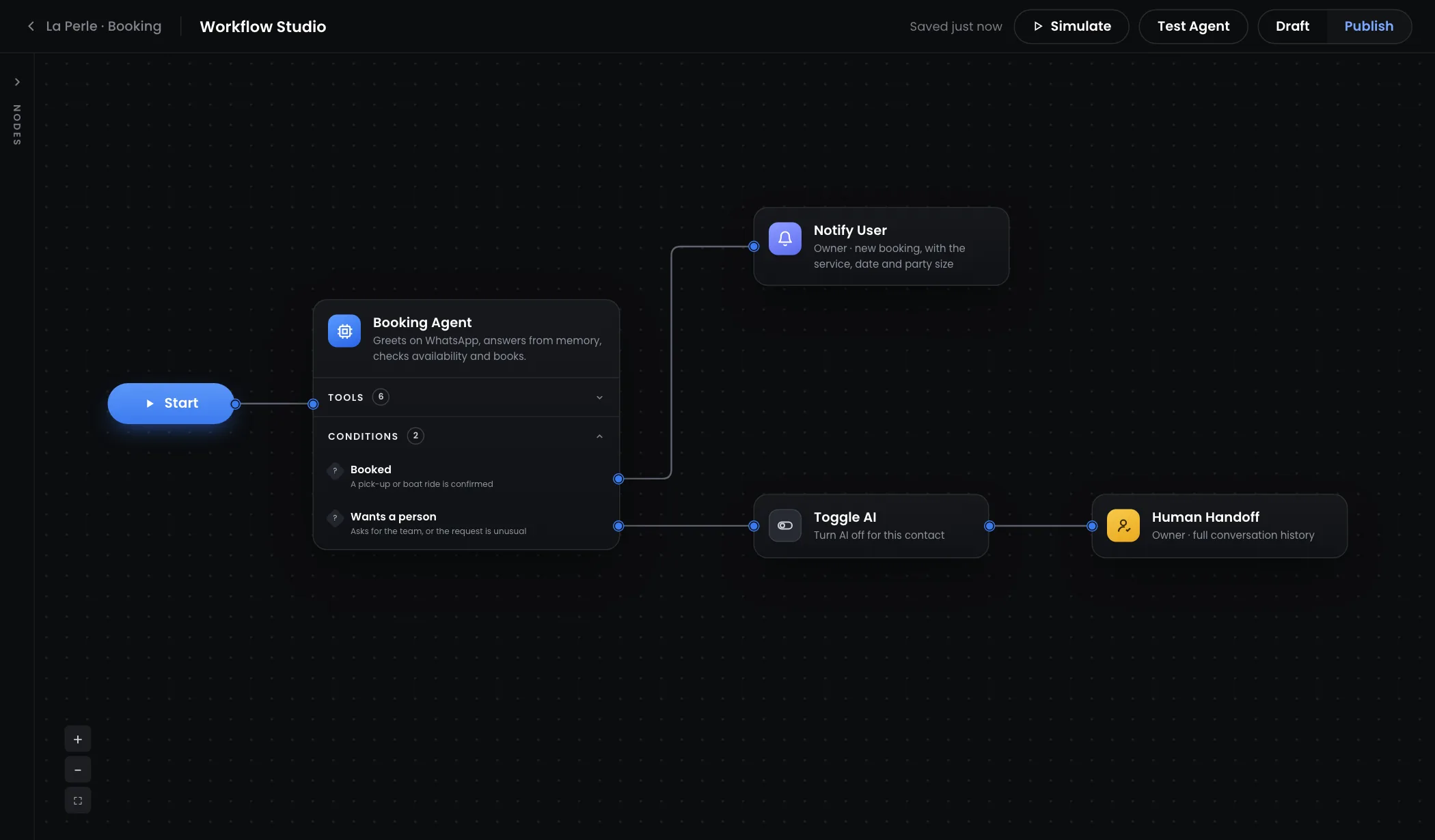
The Booking Agent is the centre of it. Its job is simple to describe: greet the customer, answer their questions, check availability, and book.
To do that, it has a small set of tools:
- Search Memory, for any question about the business and its services
- Ask Qualification, to collect the customer’s name and email before booking, which the confirmation email needs
- Update Contact, to save anything useful, including the party size
- Schedule Appointment, once a date and time are confirmed
The interesting part is the calendars. La Perle runs four services, and each has its own calendar:
- Private airport pick-up
- Grouped airport pick-up (van)
- Grouped airport pick-up (bus)
- Boat ride
The agent picks the right one based on what the customer wants and how many people are travelling. A family of six doesn’t get offered a private car. A couple doesn’t get booked onto a bus they didn’t ask for.
When a booking lands, two things happen. The owner gets a notification with the service, date and party size, and the main calendar is updated, so the team always has one view of the day.
And when a customer asks for a person, or the request is something the agent shouldn’t handle alone, the workflow turns AI off for that contact and hands the conversation to the owner with its full history. Nobody has to repeat themselves.
2. The knowledge base
The agent answers from memory: the list of services, the policies, and the pricing. When someone asks what a boat ride costs or what happens if a flight is delayed, the answer comes from what La Perle wrote down, not from a guess.
This is also the part the La Perle team keeps editing. A new price or a new policy goes into memory, and the agent uses it in the next conversation.
3. Voice notes and languages
On WhatsApp, a lot of people don’t type. They talk. The agent listens to voice notes and replies in text, so the customer can speak naturally and still get a written answer with the time, the price and the pick-up point they can scroll back to later.
Language works the same way. The agent defaults to French and recognises Haitian Creole keywords, so customers can write the way they’re comfortable and still get somewhere.
4. Mimi, the persona
An agent that answers correctly but sounds like a form doesn’t fit a business that lives on WhatsApp. La Perle wanted it to sound like their team.
So they created a persona called Mimi, and we built her with the Persona Emulator: instead of describing a voice from scratch, you feed it real messages your team has already sent to customers, and it works out how they write.
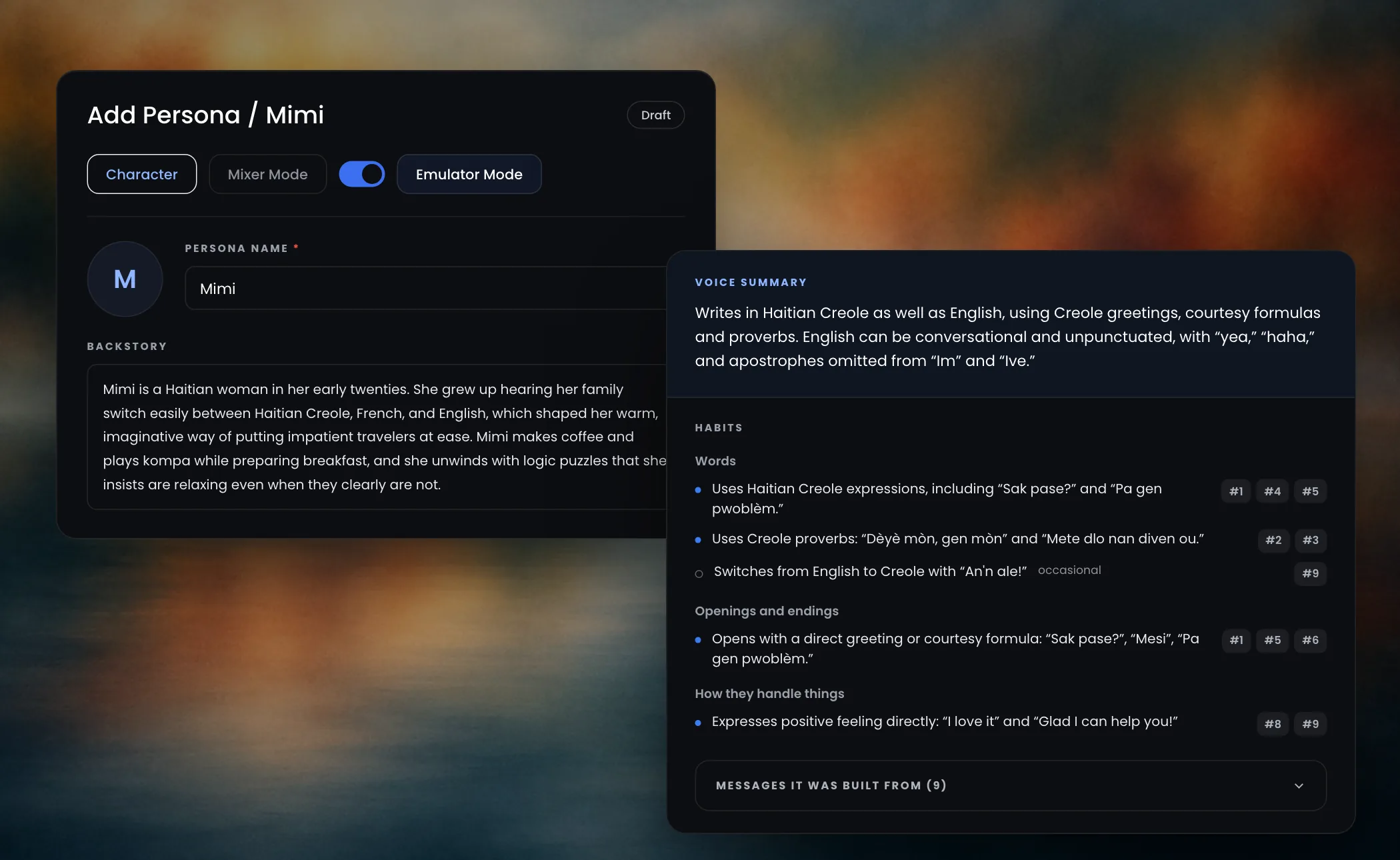
From nine real messages, the emulator picked up the details that make the team sound like themselves: opening with “Sak pase?”, “Mesi” and “Pa gen pwoblèm”, the occasional Creole proverb, and a warm, direct way of saying “Glad I can help you!”
That’s the difference between an agent customers tolerate and one they actually like talking to.
5. The feedback workflow
The booking is only half the job. La Perle also wanted to know how every trip went, and to turn happy customers into reviews.
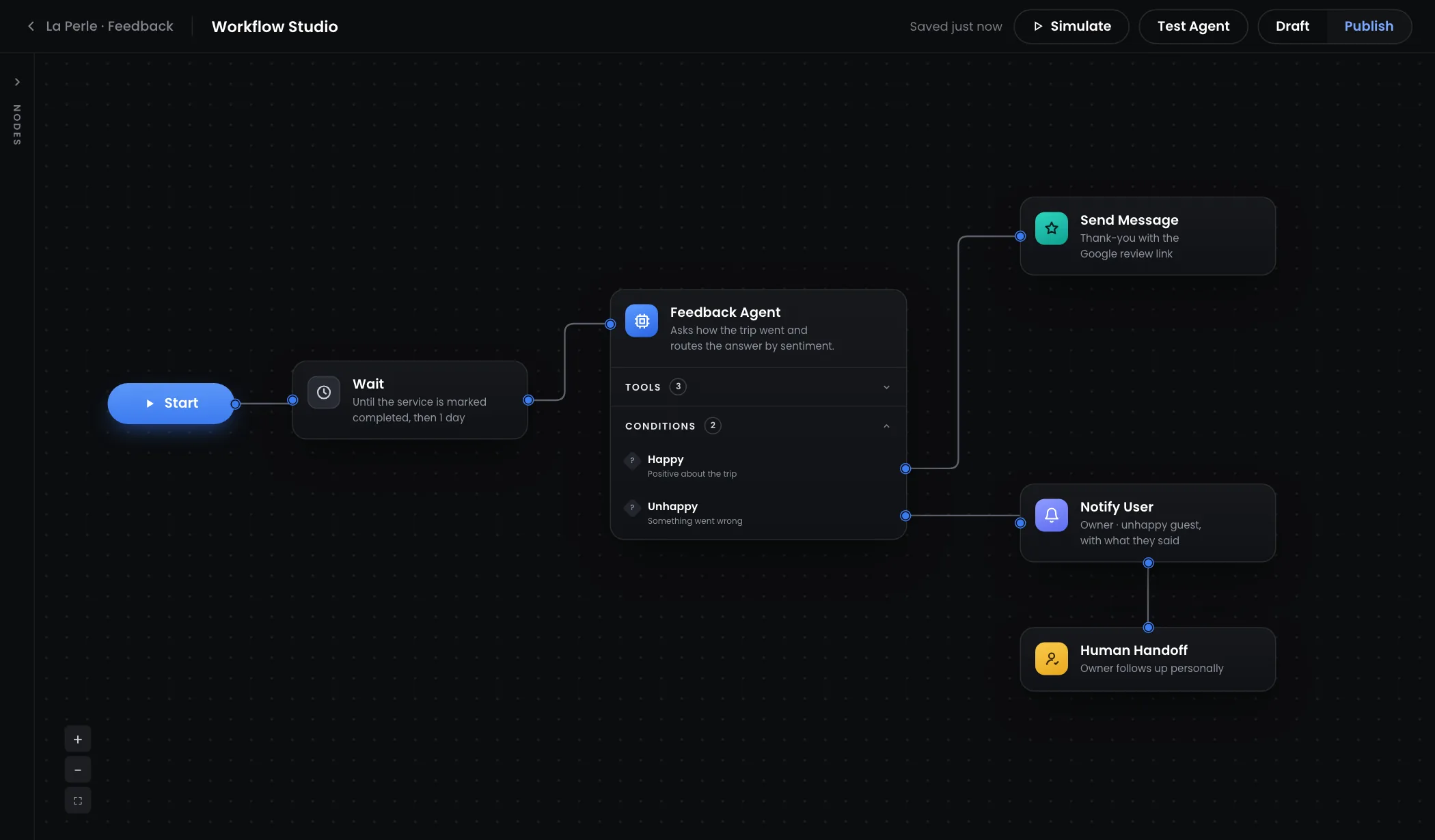
After the service date, once the booking is marked completed, the contact is assigned to a separate Feedback Agent. It checks in and asks how the trip went.
- If the customer is happy, they get a thank-you with La Perle’s Google review link.
- If something went wrong, the owner is notified with what the customer said and follows up personally.
Happy customers get asked at the moment they’re most likely to leave a review. Unhappy customers reach a person before they reach a review site.
Who this works for
La Perle is a travel agency, but nothing about this build is specific to travel.
Businesses with multilingual customers. If your customers write in more than one language, message on WhatsApp, or send voice notes, the same workflow applies: one agent, answering from your own knowledge base, booking into your calendars, in the language the customer chose.
Businesses that deliver a service and need the follow-up. Clinics, salons, home services, rentals, tours. Anyone who books a service, delivers it, and wants to hear back afterwards can reuse the feedback workflow almost as-is.
Agencies building this for clients. A build like this takes under 30 minutes, and it does the work of a front-desk hire. Agencies build agents like this for their clients and bill a monthly fee to run them, the way they’d bill for an employee on contract. On Myna, every client gets their own workspace under your brand, and you set the price.
Build your own
The whole thing, booking workflow, knowledge base, voice notes, persona and feedback loop, is built from parts that are already in Myna. You don’t need a developer, and you don’t need to write a prompt longer than a page.
If you have a business that lives on WhatsApp, or clients who do, it’s worth 30 minutes to see what yours looks like. Plans start free.